Red-pencil corrections and fingerprints appear on some of Giuseppe Terragni’s full-size drawings held at the Colombo’s Archive in Milan. Curator Melania Andronic, who found the marks while cataloguing the drawings, interprets them as traces of the architect’s involvement in production trials at the factory.
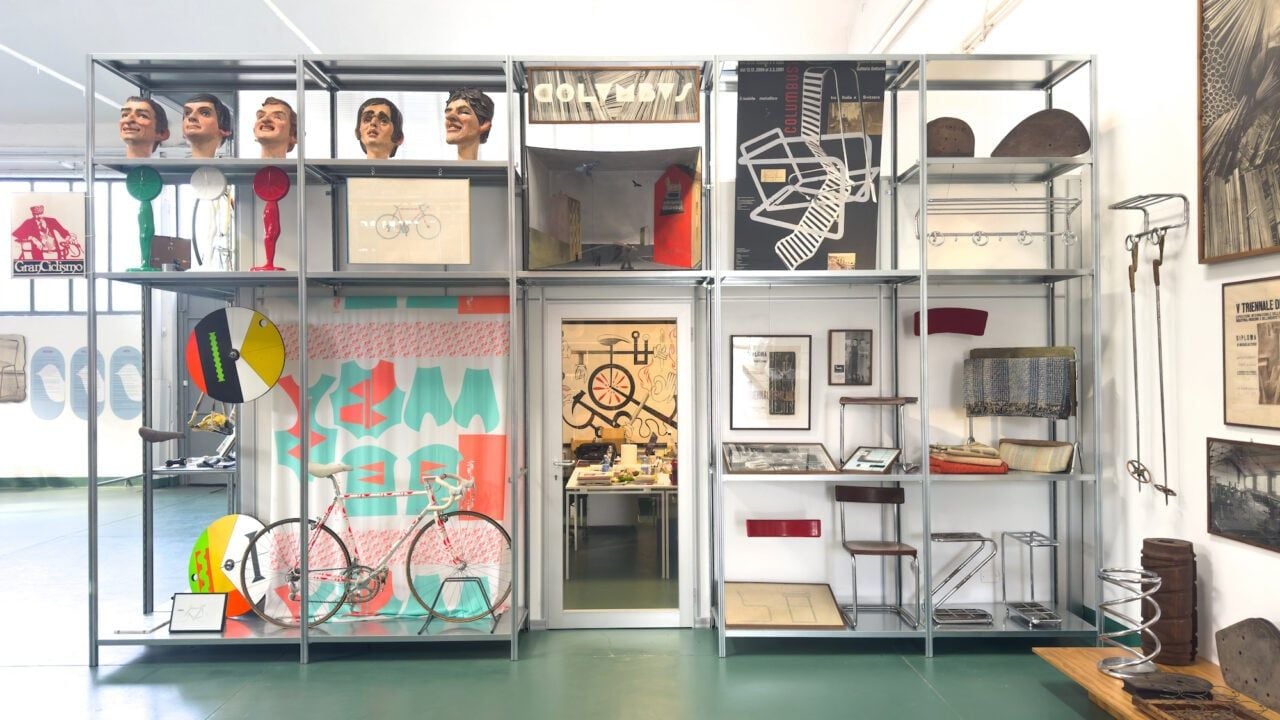
The drawings belong to a collection of furniture, documents, catalogues, bicycles and artworks connected to the Colombo family. Steel tubing is the link between furniture and cycling. Founded in 1919, A.L. Colombo made precision tubes for a range of uses, including bicycle frames, before it began producing furniture.
The company’s experience of working with steel found another use in furnishings. Between 1932 and 1933, it acquired exclusive rights from the Swiss companies Embru and Wohnbedarf to produce Marcel Breuer’s furniture in Italy. Under the Columbus name, chrome-plated tubular steel became chairs, armchairs, desks and umbrella stands. The furniture remained in production until 1965, with Italian architects including Terragni and Giuseppe Pagano also contributing designs.
The connection to cycling continued through Columbus, established in 1977 as a separate company dedicated to steel tubes for bicycles. The following year, Antonio Colombo, son of the founder Angelo Luigi, became the majority shareholder in Cinelli. In the archive, bicycles sit alongside furniture, documenting different uses of the same material.
Finished objects are joined by prototypes, photographs, catalogues and wooden production moulds. Some furniture frames are preserved without upholstery, leaving their metal structures visible. Together with the drawings, these materials offer a close look at the relationship between design and construction.
The collections can be visited and consulted by appointment, whether for personal interest, study or professional research.