In 1868, a painting by Mary Cassatt was accepted at the Paris Salon for the first time. The Mandolin Player marked a milestone for a young American artist seeking recognition in Europe. The Salon was then a crucial route to that recognition, with admission determined by a jury.
Cassatt had begun studying at the Pennsylvania Academy of the Fine Arts in 1860 before continuing her training in France with private teachers, including Jean-Léon Gérôme. Copying the old masters in museums formed part of her education. When the Franco-Prussian War forced her to return to the United States, her work as a copyist also provided a means of leaving again: in 1871, a commission from the bishop of Pittsburgh for copies after Correggio enabled her to return to Europe.
Over the following years, she continued to exhibit at the Salon while also sending paintings to exhibitions elsewhere in Europe and in the United States. Degas noticed her work at the Salon in 1874, recognising a sensibility close to his own. His invitation to join the Impressionists came in 1877, by which time Cassatt had years of training and participation in official exhibitions behind her.
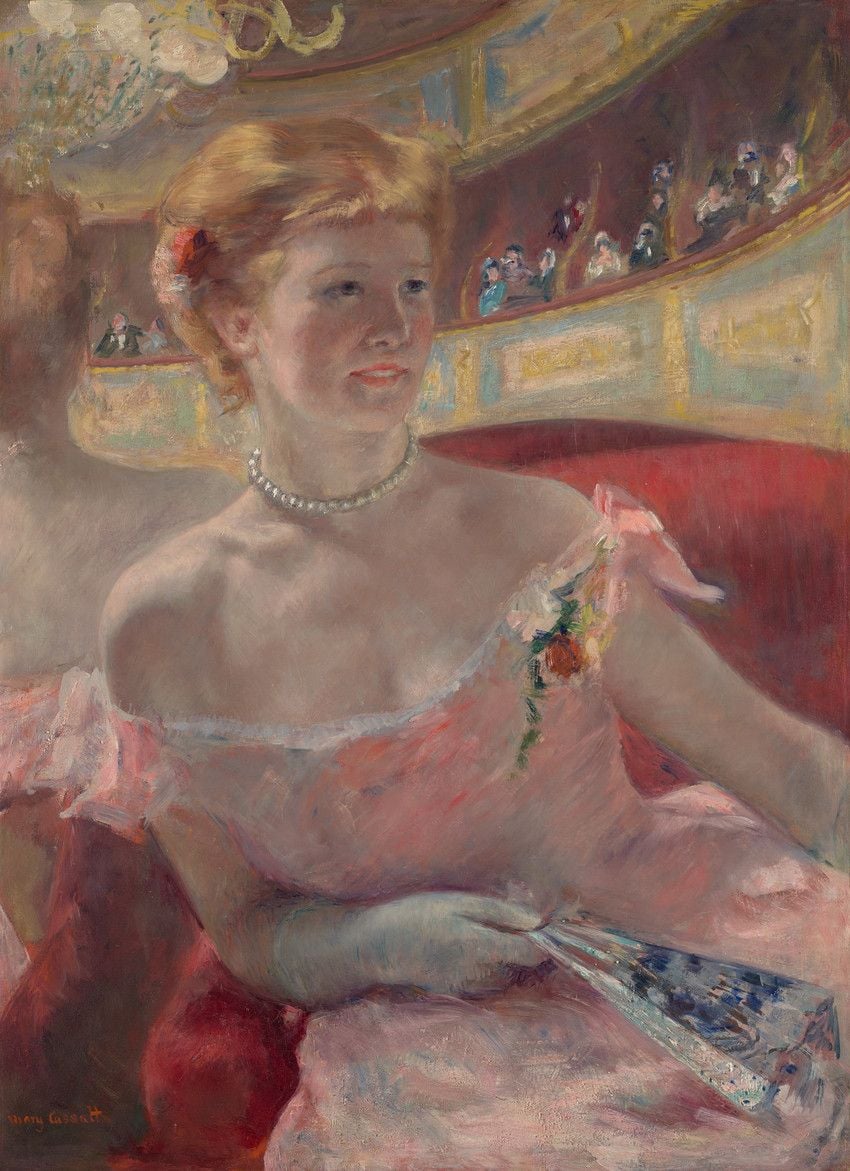
The invitation offered different conditions for showing her paintings. The group’s exhibitions, launched in 1874, called themselves independent and had neither juries nor prizes. Cassatt joined them, developing broader, more spontaneous brushwork, a luminous palette and a growing interest in pastel and printmaking. The freedom to exhibit came with opportunities to work alongside artists pursuing related interests.
She and Degas began an exchange that continued over the following decade. Both concentrated on the human figure and contemporary life; they sought each other’s advice and encouraged one another to experiment with materials and techniques. For a time, they also collaborated in printmaking.
Cassatt made her Impressionist debut in 1879 and took part in the exhibitions of 1880, 1881 and 1886. Her contribution extended to the work of making those exhibitions happen: she helped organise them, provided financial support, and purchased and lent works of art.