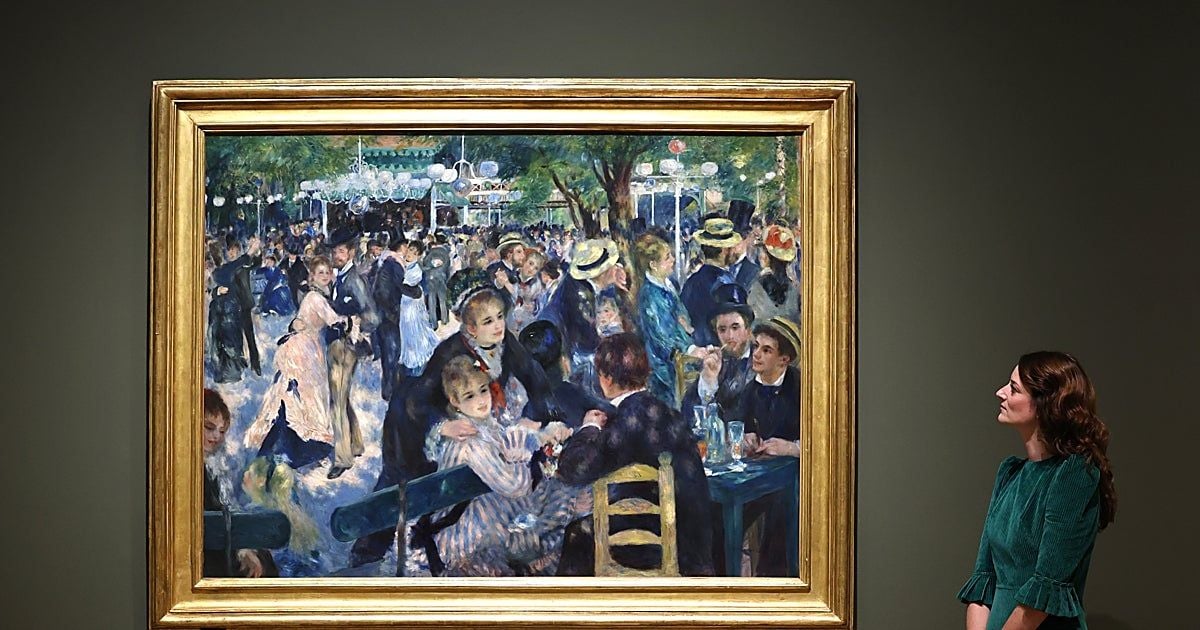
In Renoir’s 1876 Bal du moulin de la Galette, some people dance outdoors while others talk around tables. Set in Montmartre, the large painting brings couples and small groups together, making their encounters its subject. On loan from the Musée d’Orsay, it is among 45 works in Renoir and Love at London’s National Gallery from 3 October 2026 to 31 January 2027.
The exhibition focuses on work made between the mid-1860s and the mid-1880s. Cafés, theatres, gardens and the banks of the Seine provide settings for courtship, friendship and family life. It looks at how Renoir gave these relationships form through gestures, glances and the space between figures.
As early as 1866, Renoir chose a large canvas for Cabaret de la mère Antony, depicting everyday life in a format traditionally associated with religious and mythological subjects. He continued this approach in his paintings of dances. In Dance at Bougival, made in 1883 and on loan from the Museum of Fine Arts, Boston, the dancers are almost life-size.
The places where people meet are central to the Musée d’Orsay’s reading of these paintings. Frequented by people from different social classes, they offered room for freer relationships in a society still shaped by bourgeois conventions and religious morality. The museum also notes that Renoir’s depictions retain gender stereotypes: the harmony of his painted scenes does not capture the full complexity of relationships between women and men at the time.
Renoir knew these settings well. In the 1870s, he painted in Montmartre, asking friends and women who modelled for him to pose in his garden and at the Moulin de la Galette. In his apartment on rue Saint-Georges, he depicted smaller gatherings. Conversation became the focus of intimate paintings in which speaking and listening are ways of forming a bond.
In the Musée d’Orsay’s interpretation, love also encompasses friendship, family affection and the pleasure of being together. Moving from crowds to groups of just a few people, the exhibition shows how Renoir made these relationships part of his depiction of modern life.