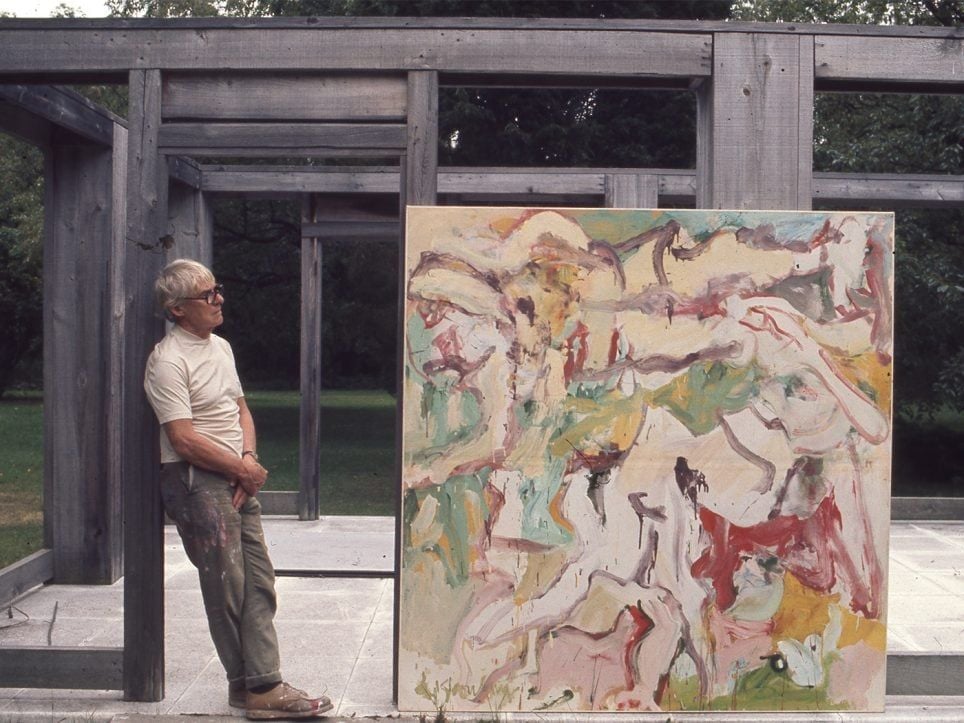
Brushes, paint tubes and tins, palettes and a large easel remain in Willem de Kooning’s studio in Springs, on Long Island. There are annotated colour tests, too, alongside several large canvases from his later years. His family maintains the house and continues to stay there, as Daphné Bétard describes in her report for Beaux Arts. Research by the Hirshhorn Museum examines the materials de Kooning used. By studying paintings from different periods, the museum has documented changes in both the composition of his paints and the ways he applied them. In Woman (1948), analysis identified commercial paints mixed with granular materials, including fragments of glass. De Kooning used brushes, palette knives and scrapers to create different surface textures. For Woman, Sag Harbor (1964), he mixed artists’ oil paints with safflower oil, water and solvent. The more fluid paint, combined with the smooth surface of the support, allowed rapid brush movements, while the slower drying time gave him longer to work into the wet paint. Drawing offers another way to understand his working methods. It is the focus of Willem de Kooning at work, at the Rijksmuseum in Amsterdam from 9 October 2026 to 17 January 2027, organised in collaboration with the Art Institute of Chicago and the Willem de Kooning Foundation in New York. Bringing together more than 120 works spanning over 65 years, the exhibition places drawings alongside a selection of paintings and sculptures. The Rijksmuseum presents drawing as a means of exploration rather than preparation for painting: making marks, revising them and returning to them were fundamental to de Kooning’s practice. At Springs, the tools and colour tests survive; in the drawings and painted surfaces, stages of the work can be traced. Technical analysis shows that even paintings that appear swift and spontaneous, such as Woman (1948), were built up in several stages through deliberate choices about materials.
Mirabilia
Willem de Kooning at Work: Experimenting with Paint and Drawing
Tools and colour tests remain in de Kooning’s Springs studio. Technical studies of his paintings and the Rijksmuseum’s exhibition of his drawings reveal an artist continually experimenting with materials and methods.
PT
18 Oct 2026
3 min read