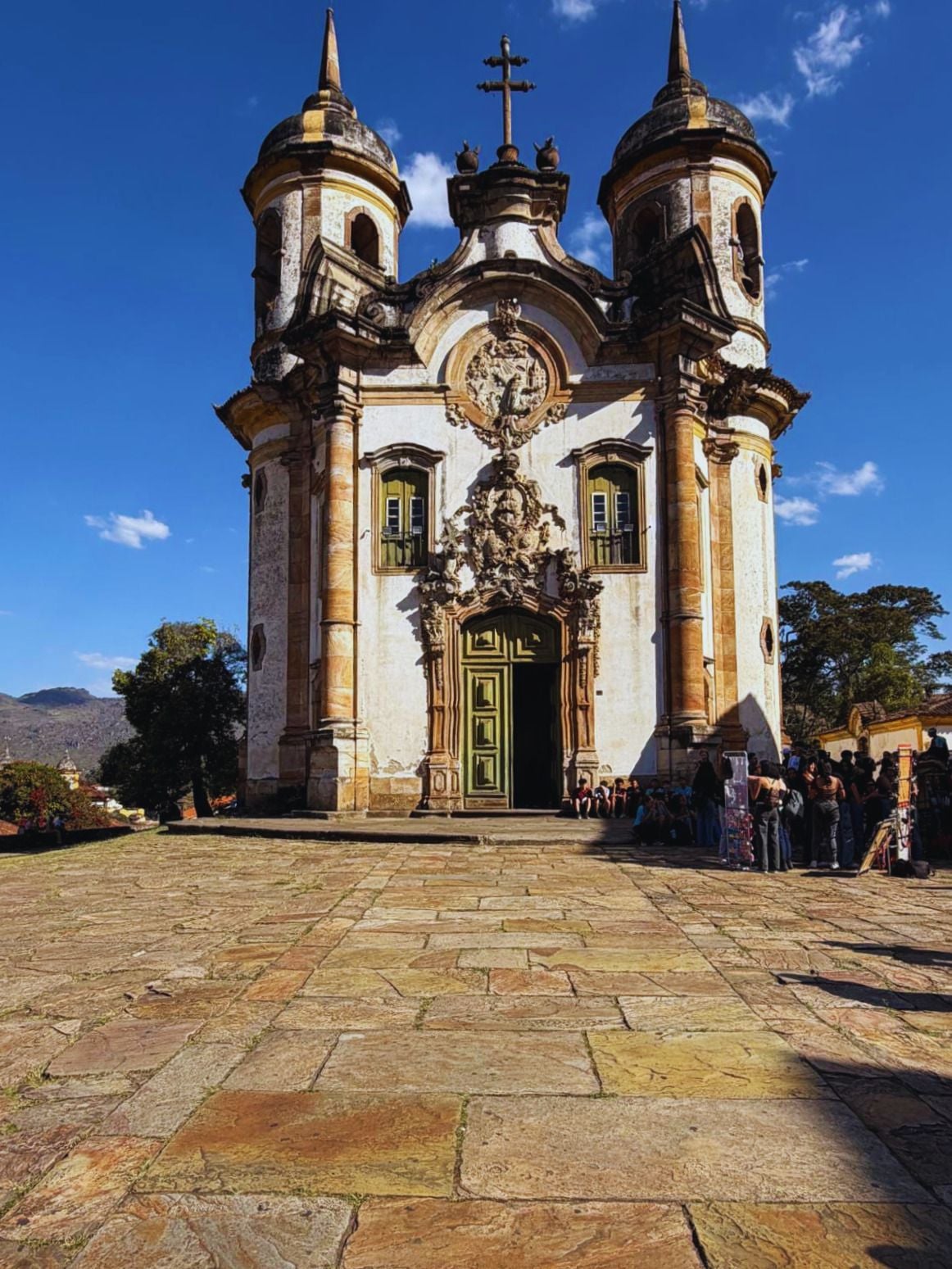
Above the entrance of a church in a mining town in Brazil, a stone face has been watching the street for roughly two centuries, and it is starting to lose the fight against time. The medallion depicts St Francis of Assisi. It sits on the facade of the Church of St Francis in Ouro Preto, widely considered one of the masterpieces of Aleijadinho, the architect and sculptor whose work defined Brazilian Baroque and Rococo. The sculpture shows its age: cracks, erosion, the slow chemical toll of two hundred years of weather. Conservators first documented damage to it in the 1920s. They have never really stopped watching it since.
What is new is who has started watching too.
In the last week of August, in Belo Horizonte, a meeting took place that could turn one of Latin America's most studied churches into a testing ground for one of Europe's most ambitious heritage technologies. Franco Niccolucci, Scientific Coordinator of ARTEMIS, an EU-funded project building what it calls Reactive Heritage Digital Twins, was in Brazil as a keynote speaker at an international colloquium at the Universidade Federal de Minas Gerais (UFMG). There he met three researchers, Professors Luiz Souza, Willi de Barros Goncalves and Yaci Ara Froner, who between them lead teams studying the St Francis church from three different angles: conservation science, digital modelling and art history.
A Reactive Heritage Digital Twin is not just a 3D scan sitting in a folder. It is meant to behave more like a living model: a digital replica of a monument or artefact that can absorb new scientific data over time and be used to simulate what happens if conservators intervene in one way rather than another, before anyone touches the real stone. ARTEMIS has been developing the concept and applying it to heritage sites across Europe. Ouro Preto would be its first outside the continent.
The reason the fit looks so promising is what the Brazilian team has already built. Decades of work on the church have produced an unusually rich archive: historical research, chemical analyses of the mortar, thermography, UV fluorescence imaging, and digital models generated through LIDAR, photogrammetry and 3D scanning. The teams have also invested in something easy to overlook but essential to any future collaboration: shared vocabularies, thesauri and documentation standards designed for interoperability, the unglamorous groundwork that decides whether two research infrastructures on different continents can actually talk to each other.
There is a human layer to the data too. The church was built between the second half of the eighteenth century and the end of the nineteenth, funded and constructed through the involvement of congregations, groups of citizens organised around shared interests and trades. That collective effort left the building wrapped in intangible heritage, in stories and civic identity, that is still part of Ouro Preto's life today, a town whose perfectly preserved colonial architecture, born of gold-mining wealth, earned it UNESCO World Heritage status.
If the collaboration goes ahead as discussed, the St Francis medallion's digital twin would do more than store information. Researchers could run simulations of proposed conservation treatments, testing consequences virtually before committing to physical intervention, and could deploy AI tools similar to ARTEMIS's existing Oracle and ARTEMISIA systems to interrogate the assembled knowledge base directly.
For now, what exists is an opening: a meeting, a shared archive, a roadmap still to be written. But if it holds, a stone saint carved by a disabled artist working in colonial Brazil, watching over a street built on gold money, may end up guiding how Europe's heritage scientists think about preserving monuments an ocean away.