Visiting a museum or an archaeological site means encountering specialist terms that help us understand objects, contexts and landscapes from the past. Making this terminology accessible through sign languages also requires careful work involving interpretation, discussion and mediation.
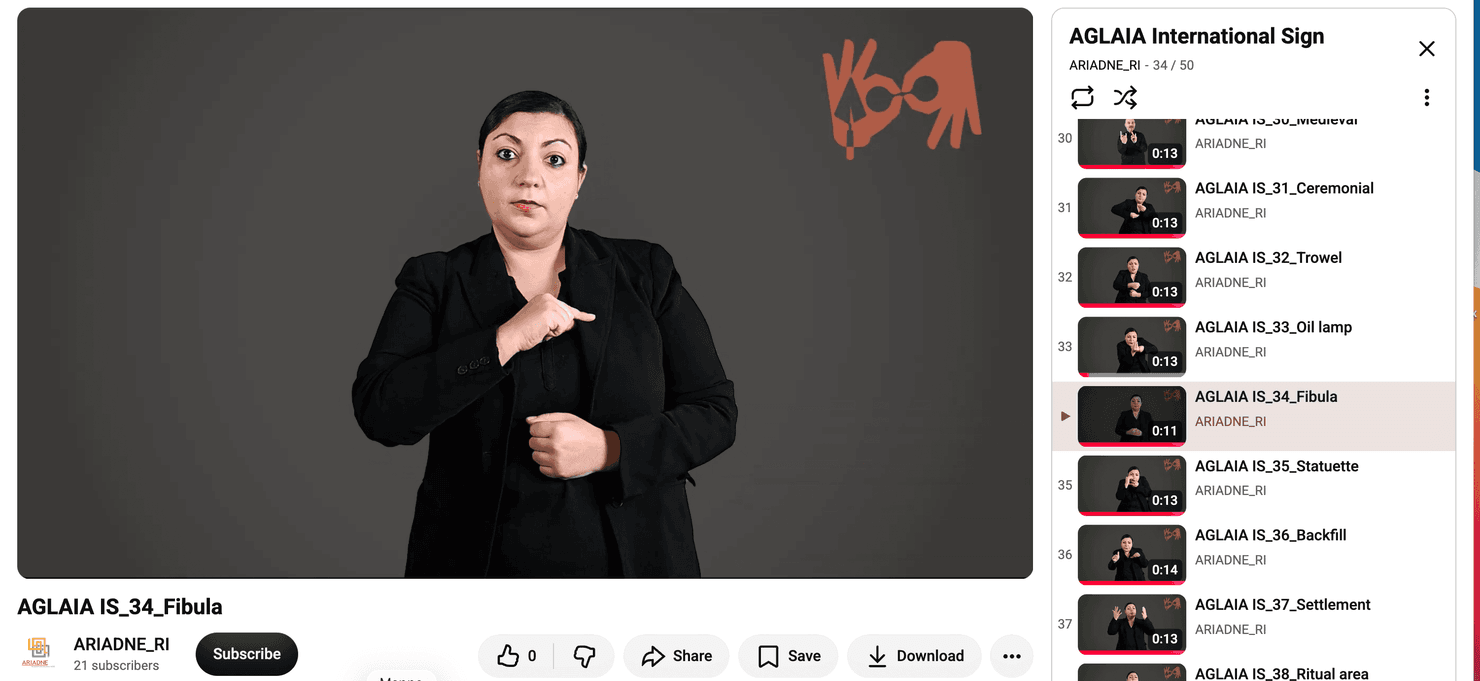
This need led to the development of AGLAIA – ARIADNE Glossary in LIS And IS for Archaeology, an archaeological glossary in Italian Sign Language (LIS) and International Sign (IS).
AGLAIA was developed within ATRIUM, a European project dedicated to research in the arts and humanities, by PRISMA CULTURA and the ARIADNE Research Infrastructure. PRISMA is a benefit company working to make cultural heritage more accessible. ARIADNE is an international non-profit association that brings together research institutions and integrates archaeological data and digital services.
The name refers to Aglaia, one of the Three Graces in classical mythology, a symbol of beauty, splendour and harmony: a reference that effectively conveys the idea of an archaeology that can be understandable, welcoming and shared.
The work began with an initial list of 200 specialist terms compiled by ARIADNE’s international network. A scientific committee selected 50 of them, choosing terms that are general but not generic, relevant to the museum experience and able to communicate archaeology without oversimplifying it.
The selected terms were then discussed and assessed with accessibility experts, Deaf translators, and interpreters of Italian Sign Language and International Sign. The proposals were recorded on video, reviewed by the working group and approved through a shared process.
Alongside LIS, International Sign plays an important role in the project. It is not a standardised language, but rather a form of communication used in international contexts to facilitate understanding between people who do not share the same sign language. It is a dynamic form of communication that also relies on facial expressions and classifiers and requires an ongoing process of discussion and mediation.
The glossary is designed for use in museums and archaeological sites, during guided tours and in educational activities. It provides museums, professionals, interpreters and educators with a resource to make the communication of archaeology more accessible and to encourage broader participation by Deaf people in cultural experiences.
AGLAIA brings together archaeological knowledge, linguistic expertise, accessibility and the direct experience of the people involved. The process shows how accessibility can be integrated into the design of cultural content from the very beginning, becoming not an addition at a later stage, but an integral part of the way cultural heritage is communicated, interpreted and shared.