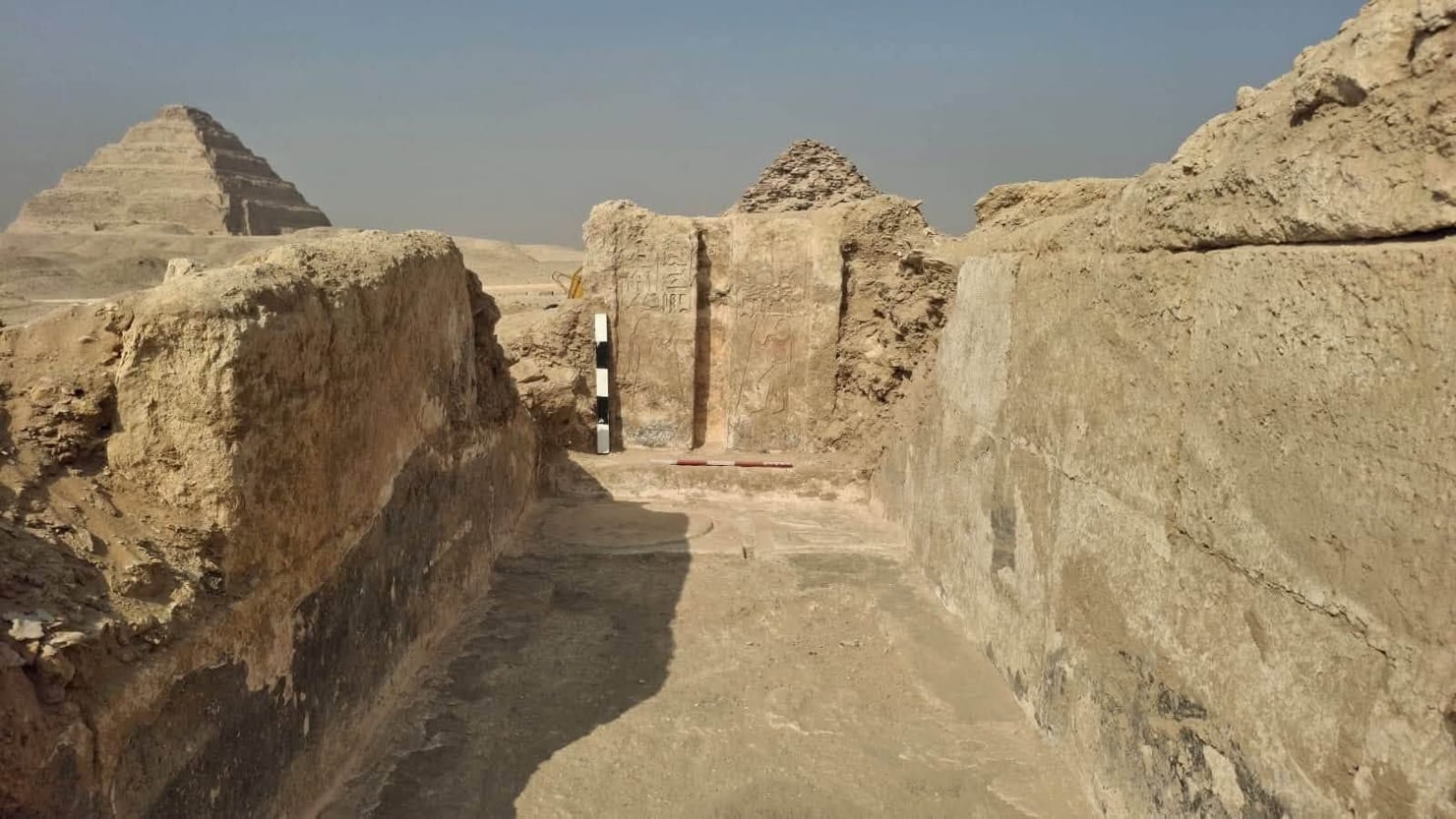
The door is real. The stone is carved, the frame is precise, the threshold is worn smooth by four thousand years of sand. But walk up to it and put your hand on it, and you find there is nothing behind it. No room, no corridor, no tomb chamber waiting on the other side. Just rock.
That was always the plan.
Archaeologists working at Saqqara, the vast necropolis south of Cairo, have uncovered a false door inside the tomb of a man named Sekhentiu-Ptah, buried some 4,000 years ago. Egypt's Ministry of Tourism and Antiquities announced the find last week, alongside an offering table, a purification basin, and a network of burial shafts nearby that still held human remains and funerary goods, including more than a hundred small faience figurines called ushabti, meant to serve the dead as labourers in the next world.
The false door was not a mistake or a decorative flourish. According to the Metropolitan Museum of Art, ancient Egyptians believed the dead could pass through such doors freely, slipping between the world of the living and the world beyond, even though no living person ever could. It was architecture built for a ghost.
Hieroglyphic inscriptions inside the tomb name its owner and his surprisingly long list of titles: royal chamberlain, supervisor of the king's works, supervisor of royal documents, priest of the goddess Maat, supervisor of scribes. Sekhentiu-Ptah, whoever he was in life, mattered enough in death to be given a doorway to eternity carved into solid stone.
Saqqara has been giving up secrets like this since the 19th century, when it first drew serious archaeological attention. It served as a burial ground for Old Kingdom royalty and elites from roughly 2700 to 2200 BCE, and it kept being used for burials for millennia afterwards, well into the Roman era. As Manchester Museum curator Campbell Price once told Smithsonian magazine, 'Saqqara would have been the place to be seen dead in.'
The new tomb sits west of the necropolis's Bubasteion sector, named for the cat goddess Bastet, an area still being worked by Egyptian archaeological teams. Last year, a separate dig at Saqqara turned up a 4,100-year-old burial chamber thought to belong to a royal doctor. The necropolis, it seems, still has more doors left to open, real ones and otherwise.


