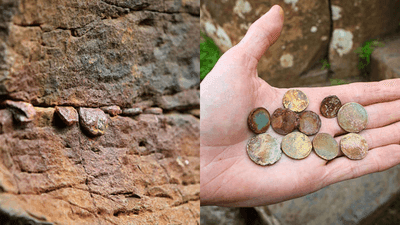
At Giant’s Causeway in Northern Ireland, more than 20 kilograms of coins have been removed from between the basalt columns. Some had been pressed into place; others had been driven into cracks using stones as hammers. Getting them out called for patience, with different tools and working times depending on how firmly each coin was lodged.
The site’s more than 40,000 columns formed around 60 million years ago as lava cooled. Their natural cracks have become places where visitors leave coins.
Technical investigations have documented corrosion, staining and changes associated with the coins. A removal trial in a small area in February 2024 found no significant physical damage to the basalt it examined. The trial did not, however, include the most corroded areas, places that were harder to reach or cracks where coins were lodged more deeply.
Cliff Henry, who leads nature engagement work for the National Trust, explains that some corroded coins can swell to three times their original thickness, putting pressure on the stone and causing fragments to break away. Many have a steel core coated in another metal. As the metals corrode at different rates, the layers can separate, while saltwater spray speeds up the process.
Removing the coins must therefore avoid adding to any existing damage. In February 2024, Cliveden Conservation carried out a trial to identify safe extraction methods before work was extended to other parts of the site.
Stone conservation specialist Nathan Morrow used pliers for coins he could reach more easily and a tool for working between joints for those lodged deeper in the rock. Some came free in seconds; others took more than 20 minutes. Henry says the project has involved around 200 hours of work. Coins that are too deep or too corroded to extract without risking further damage remain in place.
The National Trust has put up signs asking visitors not to insert more coins and suggesting the donation box instead. The work also involves regular checks: new coins have been found in the cracks since the removal. Protecting the columns means dealing with coins already there while preventing more from being added.
- National Trust — Causeway Coin Removal Project
- Causeway Coast and Glens Heritage Trust — Coin Removal Project
- The Times of India — Monete rimosse dal Giant’s Causeway
- Need To Know — William McGee
- Cliveden Conservation Workshop Limited, rapporto sulle prove di rimozione del febbraio 2024, ospitato da Causeway Coast & Glens Heritage Trust


