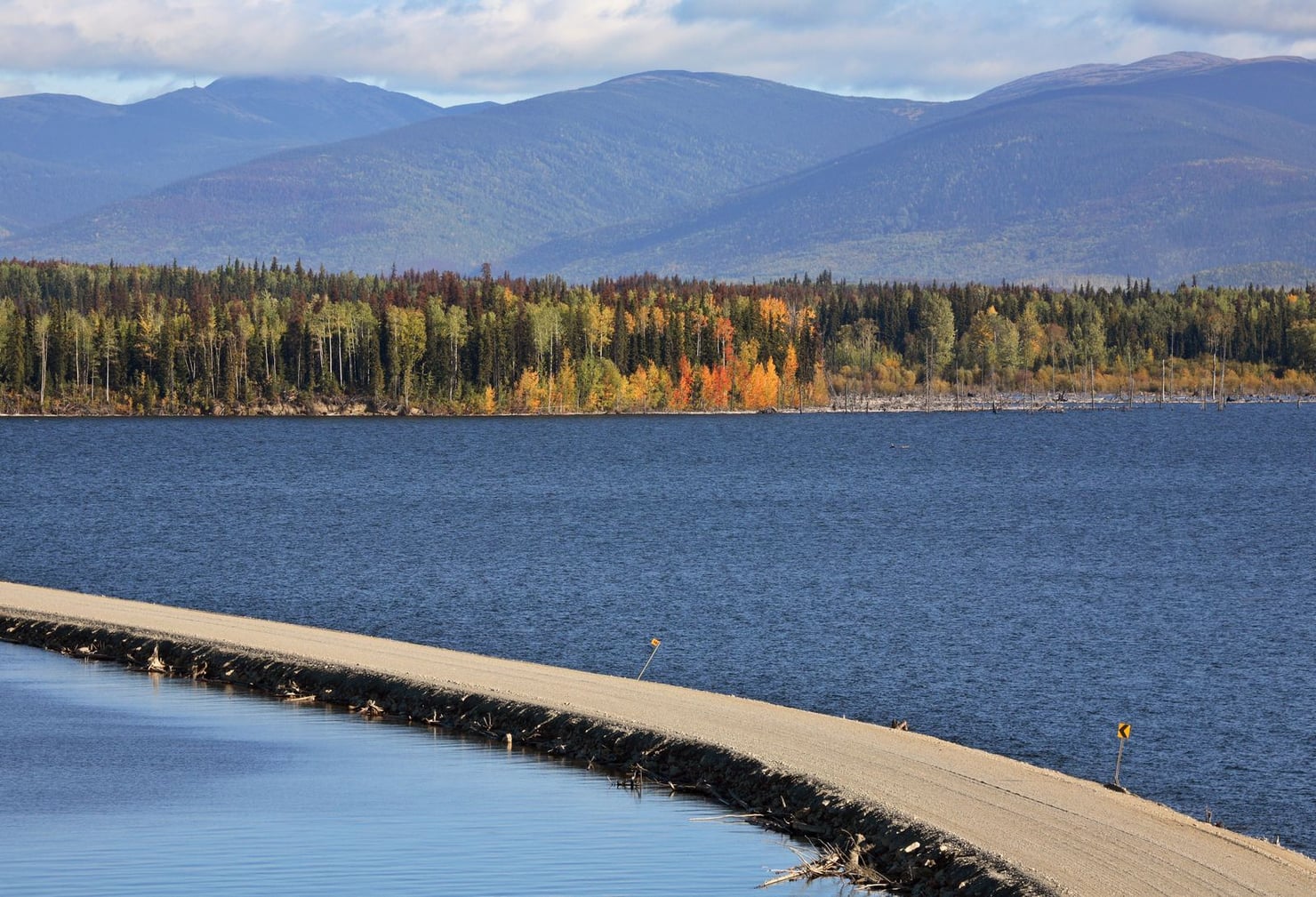
On July 21, a satellite passing over Williston Lake in British Columbia photographed something that should not have existed: a forested island, roughly 150 yards long and 75 yards wide, drifting free in one of the largest reservoirs on Earth. It had trees. It had birds. It was not on any map, and nobody had seen it before.
A local boater spotted it first, in late July, and mentioned it to a friend, Rocky Avery, who had lived in the area for forty years and had never seen anything like it. In August, Avery posted photos and video to warn people ahead of a fishing derby. The footage went viral, and Bob Gammer, spokesperson for B.C. Hydro, the utility that operates the reservoir, assumed it was an AI hoax. Then the satellite image landed on his desk, and the island turned out to be real.
Then it disappeared. By mid-August, the floating forest was gone. B.C. Hydro searched for it and, on August 31, found it again: nearly twenty miles northwest of where it had first appeared, having drifted about 30 kilometres in fifteen days.
Gammer's working theory is that the island formed over years from logs and woody debris piling up along the shoreline, slowly decomposing into enough soil for plants and trees to take root. Williston Lake is currently at its highest level in fourteen years, thanks to heavy snowpack and summer rain, and Gammer thinks that rising water simply lifted the whole mass off the shore and carried it into open water.
Not everyone buys it. Geologist John Joseph Clague of Simon Fraser University told the Canadian Press that shoreline trees do collapse into lakes regularly, but they do not usually knit themselves into a raft this large. He remains, by his own admission, perplexed.
Rebecca Helm, a marine ecologist at Georgetown University, offers a different frame entirely. Floating forested islands, technically bogs, used to be common before large-scale logging and damming choked off the flow of woody debris downstream. One well-known example, Wisconsin's Forty Acre Bog, drifts toward a bridge on Lake Chippewa so reliably that locals push it back with boats nearly every year. Seen that way, Williston Lake's wandering island is not an anomaly at all. It is a ghost of how lakes used to behave, before humans tidied their shorelines.
B.C. Hydro is asking people to admire it from a distance: the base, Gammer says, is a thin and unstable raft of logs, unsafe to climb or moor a boat against. The island, for now, is simply floating, somewhere, still full of birds.


