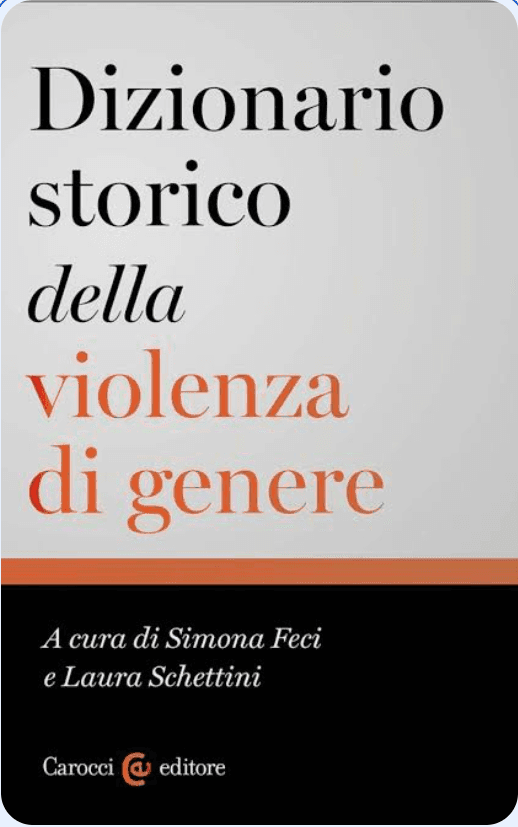
“Home” and “night” are everyday words. In the Dizionario storico della violenza di genere (Historical Dictionary of Gender-Based Violence), they become starting points for exploring how gender relations shape places and experiences. Alongside terms such as “consent” and the historical “right of correction”, they illustrate the book’s approach: interconnected entries that examine violence from different perspectives.
Edited by Simona Feci and Laura Schettini and published by Carocci, the dictionary brings together contributions from almost fifty authors. Its entries span Italian history from antiquity to the present, connecting legal systems, family life and cultural representations with women’s resistance and practices of self-defence.
In their introduction, the editors identify a recurring limitation in public debate: violence is often described either as an emergency created by contemporary life or as the expression of an allegedly unchanging male nature. The book’s historical approach examines both continuity and change, tracing the language and practices that have helped normalise violence alongside efforts to expose and oppose it.
The opening entry, written by Alessandra Gissi, takes 25 November as an example. The date was chosen at the first Latin American and Caribbean Feminist Gathering in Bogotá in 1981, before its formal recognition by the United Nations. Participants sought to commemorate the Mirabal sisters, opponents of the Trujillo dictatorship who were murdered in the Dominican Republic in 1960. Tracing the observance’s history brings the women’s activism behind it back into view.
Readers can browse the dictionary alphabetically or use its cross-references and thematic index to follow a question across several entries. The editors explicitly acknowledge that the volume cannot be exhaustive: it also identifies unanswered questions and gaps for future research. Each entry includes a bibliography for further reading. The full Italian text is available to read and download free of charge from the University of Naples L’Orientale’s institutional repository.