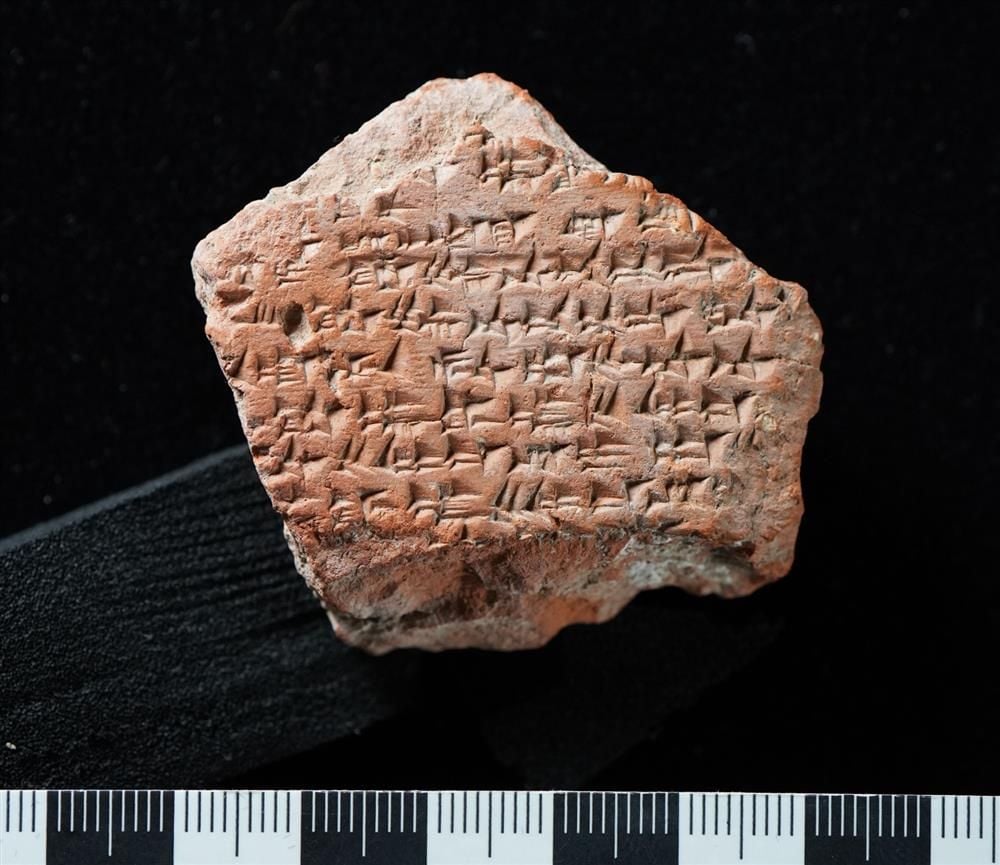
People who fled from Egypt to the Hittite kingdom, or in the other direction, were to be returned under a treaty agreed by Ramesses II and Hattusili III in the 13th century BC. A tablet fragment found at Hattusha, in present-day Turkey, preserves several lines from the part of the agreement concerning them.
The fragment was found during excavations at Büyükkale, near Building E of the Hittite royal palace. After about a year of examination, it was identified as part of the front of a copy of the treaty written in Akkadian cuneiform. Its legible sections refer to people who fled Egypt or Hatti and to a prohibition on destroying their houses. The fragment is incomplete, and Turkey’s Ministry of Culture and Tourism has not published a full transcription.
Previously known copies provide the wider context. The treaty required the return of people who had fled, but also stipulated that they should not suffer certain mutilations, and that their homes and families should not be destroyed. The newly found fragment preserves references to flight and to houses; the other protections are documented in copies discovered earlier.
The treaty was already known from hieroglyphic inscriptions on Egyptian temples and from tablet fragments found at Hattusha during excavations between 1906 and 1912. This fragment adds several lines to the reconstruction of the Akkadian copies, helping researchers read more of what the agreement said about people returned from one kingdom to the other.
- Ministero della Cultura e del Turismo della Turchia. Barışın binlerce yıllık izi Hattuşa’da gün yüzüne çıktı. https://basin.ktb.gov.tr/TR-474337/barisin-binlerce-yillik-izi-hattusada-gun-yuzune-cikti.
- Live Science. Fragment of world’s oldest known peace treaty found in Turkey. https://www.livescience.com/archaeology/ancient-egyptians/we-have-found-traces-of-peace-thousands-of-years-old-fragment-of-


