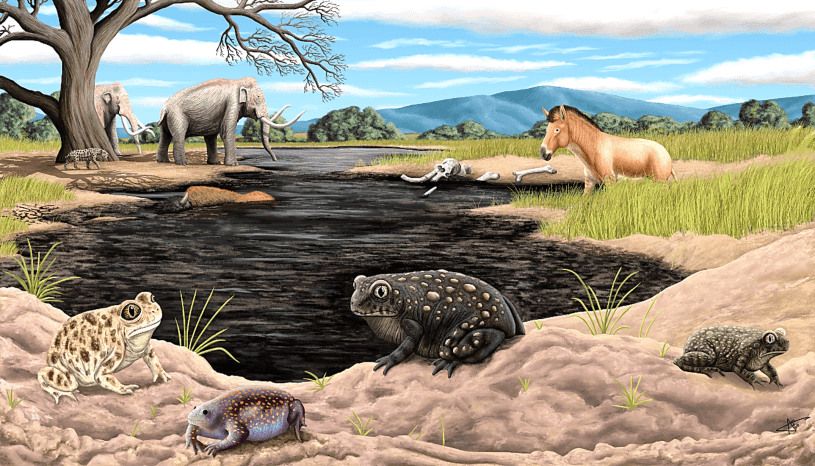
A bone the size of a fingernail sat unlabelled in a drawer at the La Brea Tar Pits for nearly a century, dismissed as belonging to a sick or injured animal, before anyone realised it belonged to no known species at all.
The fossil, recovered from the tar in 1929, has now been identified as Spea labreae, a previously unknown spadefoot toad and the first extinct Ice Age amphibian ever found at La Brea. It is only the second such discovery in all of North America. The find was published on 4 August in the Journal of Vertebrate Paleontology by paleoecologists J. Alberto Cruz and Emily Lindsey.
"I'm very happy, very excited, because it's my first new species in all my career," Cruz, who works at La Brea and at Mexico's National Institute of Anthropology and History, told Scientific American.
While mammoths, dire wolves and saber-toothed cats made La Brea famous, its amphibian collection had gone largely unexamined until Cruz began sorting through it a few years ago. He and Lindsey compared the odd bones, including a distinctive sacro-urostyle at the base of the spine, against specimens held at the Natural History Museum of Los Angeles County and Berkeley's Museum of Vertebrate Zoology. The differences held up: a new species.
Toads rarely survive as fossils outside asphalt at all; their skeletons are too delicate. That rarity is precisely what makes this one useful. Unlike mammoths, which could simply walk away from a drying landscape, toads cannot: they are tied to water and to the temperature around them, since they are cold-blooded. A toad that stayed put is a toad that tells you what the ground beneath it was actually like.
Researchers cannot yet date S. labreae precisely, since ageing it would mean destroying part of the specimen, but associated fossils suggest it lived at least 45,000 years ago. Cruz and Lindsey also identified, in the same collection, the first evidence at La Brea of a Mexican burrowing toad, a species still alive today but now found no closer than southern Mexico, 1,500 miles away.
Two small bones, then, sketching a version of Los Angeles that was wetter, and further south in spirit, than the one we know.


