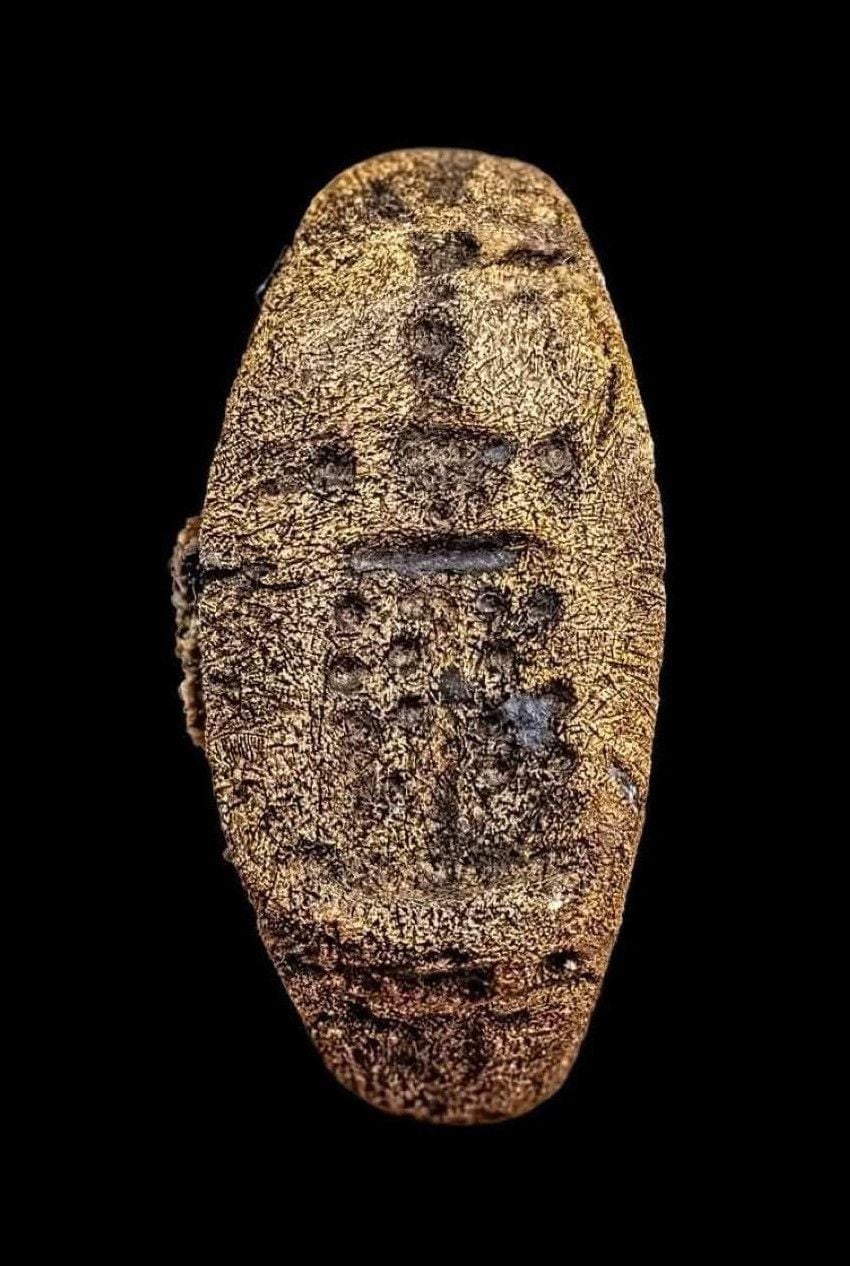
The Lighthouse of Alexandria appears in relief on a bronze seal ring found underwater in the palace area of Antirhodos. Now submerged, the island was part of the royal quarter overlooking the Portus Magnus, the city’s ancient harbour. The ring was recovered by a mission from the European Institute for Underwater Archaeology (IEASM), working with Egypt’s Supreme Council of Antiquities.
According to the mission, it is the first known seal ring to depict the lighthouse. The image resembles depictions on some coins from the second century AD, bringing a familiar representation of the monument onto a personal object. That date belongs to the coins used for comparison: the mission has not given a date for the ring.
A seal ring could be used to press an image into clay or wax. Finding this one in the palace area has also prompted archaeologists to consider what activities took place in the complex.
The geographer Strabo saw and described the palace during his travels in Egypt between 29 and 25 BC. In a statement from the Egyptian ministry, Hisham El-Leithy, secretary-general of the Supreme Council of Antiquities, suggests that the building may have remained in use until the second century AD for administrative work, perhaps including the management of the lighthouse.
Margaret Miles, emerita professor of art history and classics at the University of California, Irvine, offers another possible interpretation: the seal may have belonged to a merchant who used the lighthouse’s recognisable outline to indicate a presence in Alexandria.
The two suggestions concern different questions, the use of the palace and the possible owner of the seal, and both remain interpretations. The ring adds another image of the Lighthouse of Alexandria to the record, but cannot on its own establish what the complex was used for or who used it.