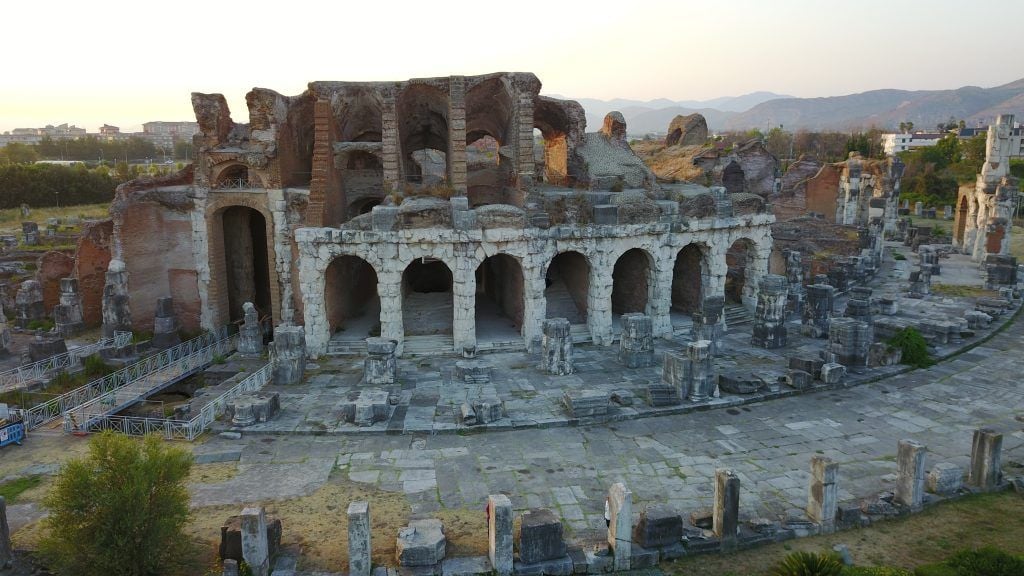
The Anfiteatro Campano in Santa Maria Capua Vetere could once hold 60,000 people. Built between the late first and second centuries AD on the model of the Colosseum, restored under Hadrian and inaugurated by Antoninus Pius, it replaced an older arena tied to the memory of Spartacus's revolt. On 5 September 2026, it will host a very different kind of spectacle: a play about how entertainment curdles into manipulation.
The piece is Progetto Cuccagna, by Gian Maria Cervo, Charis Pechlivanidis and Pablo Girolami, and it is not an isolated stunt. It is one of seven productions in Metamorfosi Campane, a touring theatre programme running from 4 September to 17 October 2026 across six archaeological museums and sites in the provinces of Naples and Caserta, backed by Italy's Directorate General for Performing Arts and staged by three companies: Ente Teatro Cronaca, Vesuvioteatro and Teatro Stabile delle Arti Medioevali.
What makes this worth watching is the method, not the calendar. Each production is written or adapted specifically for its site, so the ruins are not scenery but argument. Progetto Cuccagna, staged again on 12 September at the Museo archeologico nazionale di Sessa Aurunca and on 26 September at Naples's Parco delle Tombe di Virgilio e Leopardi, traces mass spectacle from gladiatorial combat to popular festivals, using the amphitheatre's own history of consent and control as its script.
The season opens on 4 September at the Museo Georges Vallet in Piano di Sorrento with Nessuno, Pako Ioffredo's meditation on identity built around Ulysses and the name he uses to deceive Polyphemus, staged inside a museum that traces the Sorrentine peninsula from prehistory to Rome. On 20 September, the Museo storico archeologico di Nola hosts Raccontami una tavola, drawing on Chekhov, Charles Lamb, Jack London and Poe to turn food and wine into a lens on desire and defeat. The Museo archeologico nazionale di Calatia in Maddaloni, sited along the ancient Via Appia, closes the season with two works: Favorite e Favoriti on 26 September, three female-authored dramaturgies on love and power in the Kingdom of Naples, and, on 17 October, the national premiere of Di Vie e di Amanti by Matteo Bertolotti, which turns the old Roman road itself into a stage for questions of gender and identity.
The wager here is simple and rarely attempted at this scale: that a museum's silence is not neutral, and that the right performance, in the right ruin, can make two thousand years of stone argue back.


