A fragment from the back of a skull found on the Isle of Wight has been identified as belonging to a new dinosaur species, Invictibellatrix amberina. According to a research team led by University College London, it is the first known megaraptoran in Europe. Megaraptorans were two-legged carnivorous dinosaurs with large claws. This one lived around 120 million years ago, during the Early Cretaceous.
Based on its closest relatives, palaeontologist Cassius Morrison, the study’s lead author, estimates that the dinosaur was between three and four metres long and just over one and a half metres tall. In the same reconstruction, its claws may have measured between ten and twenty centimetres.
The fossil was found by Reginald Walter Hooley, an amateur collector. The Natural History Museum in London acquired it in 1924 as part of a purchase of more than a thousand specimens from his collection after his death. It remained in the museum’s collections for about a century before being re-examined for this research.
To examine its structure, the team used CT scanning to create a three-dimensional model of the fragment and its internal cavities. They then compared it with the skulls of other carnivorous dinosaurs.
The combination of anatomical features led the team to identify a previously unknown species. According to the researchers, analyses of its evolutionary relationships place it among the megaraptorans, providing the first known evidence of the group in Europe. The findings were published in Royal Society Open Science.
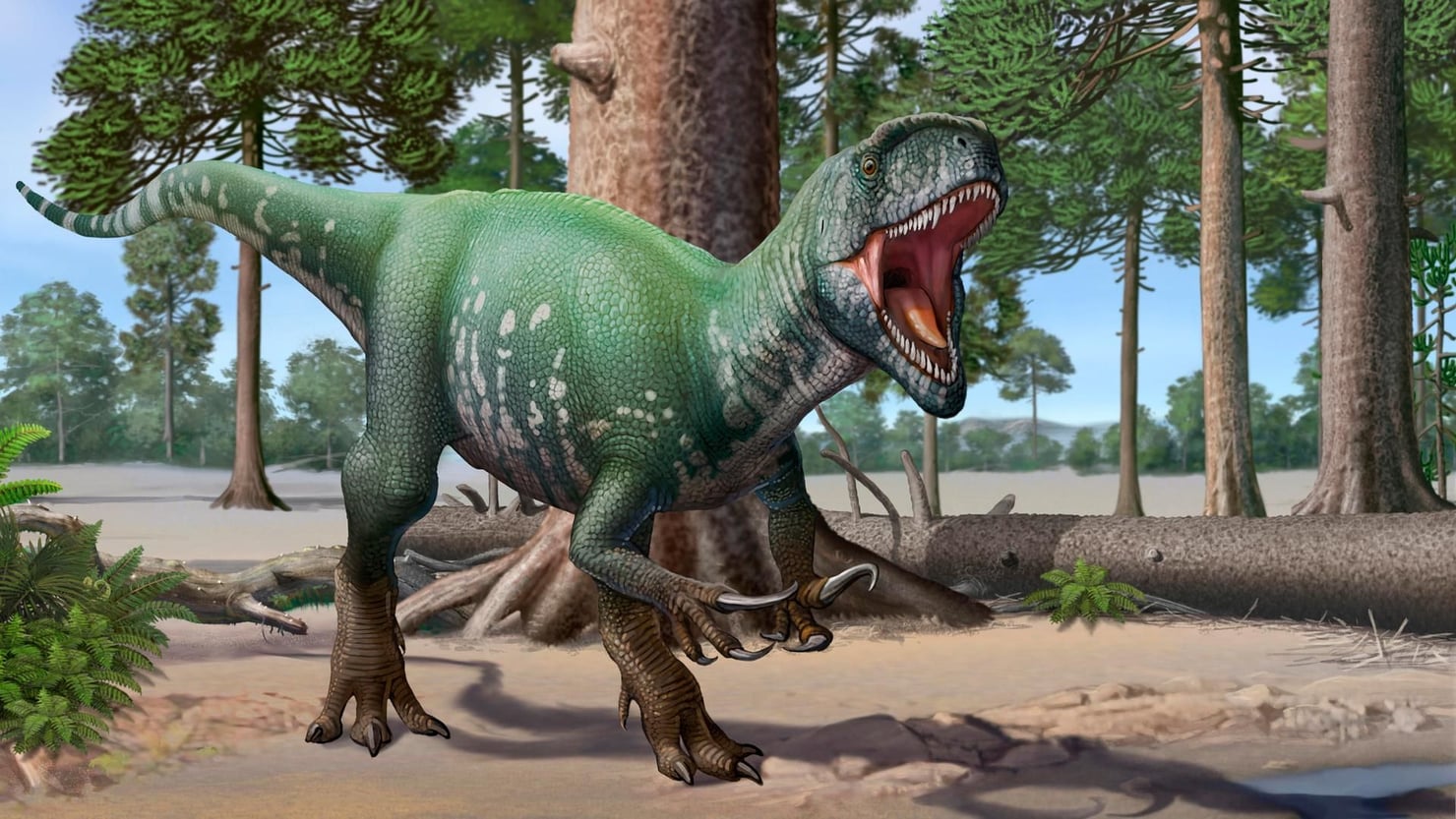
Reconstruction of Invictibellatrix amberina, centre, in the environment of what is now the Isle of Wight around 120 million years ago, during the Early Cretaceous. Illustration © Sergey Krasovskiy and Pedro Salas.
Illustration of Invictibellatrix amberina, a two-legged dinosaur with a green body and striped tail, with small mammals between its forelegs. Other dinosaurs and vegetation surround it.
Image supplied by the Natural History Museum: https://www.nhm.ac.uk/content/dam/nhm-www/press-office/new-megaraptor-reconstruction-full-width-krasovskiy-salas.jpg