At one of ancient Aquinum’s main crossroads, a decorated stone had been reused to pave the road. It was a stone marker, or cippus. Its surface preserves three animals and the name of the person who dedicated the monument, probably Caius Ammius Cammarus.
The marker was presented to visitors alongside a new fragment of a votive altar during an archaeology weekend marking the end of the University of Salento’s 18th excavation season. Led by Giuseppe Ceraudo, the excavations take place at Aquinum, near Castrocielo in the province of Frosinone.
An ox, a ram and a pig appear on the marker among garlands, festoons and bucrania, decorations shaped like cattle skulls. According to the University of Salento, the three animals evoke the suovetaurilium, a Roman rite involving the sacrifice of a pig, a sheep and a bull.
The marker has come down to us as a paving stone, however. Its reuse makes it impossible to establish with certainty where it originally stood.
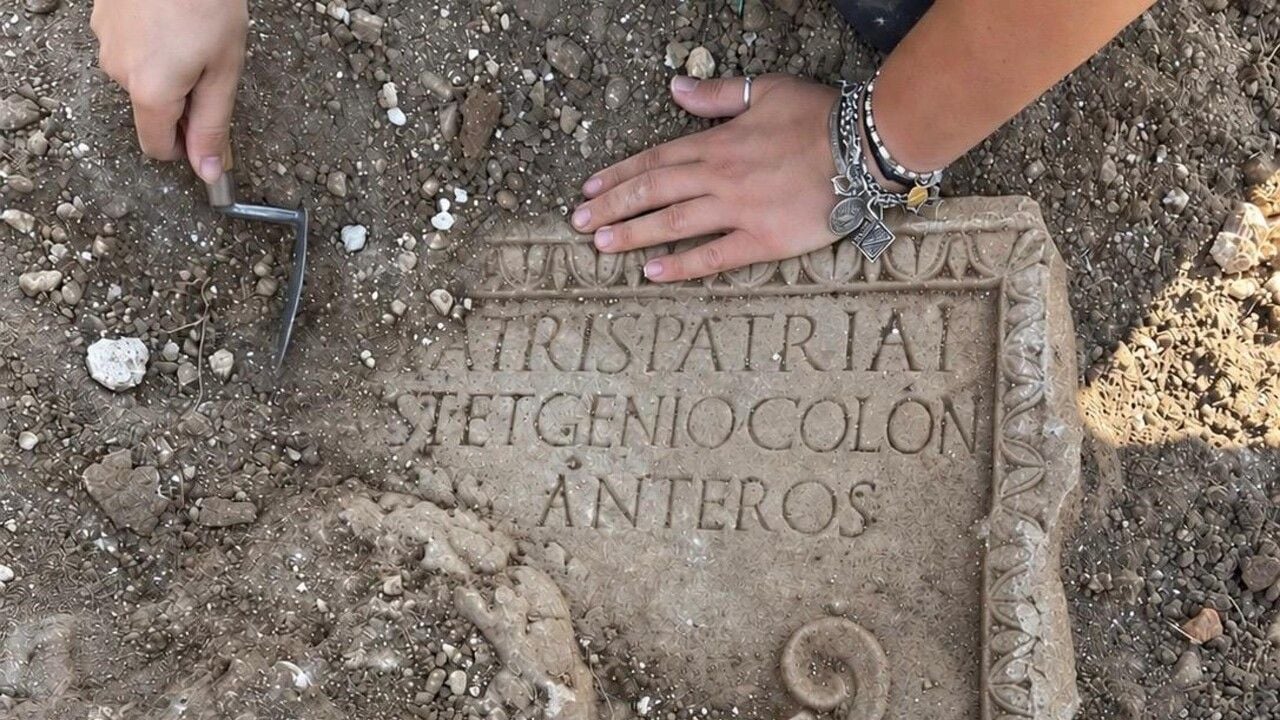
The new marble altar fragment helps reconstruct an inscription already known in part. It makes the dedication to the Genius of Augustus, the Lares of Augustus and the Genius of the colony easier to read. It also names Manius Popidius Anteros, a wealthy freedman who held the office of Augustan sevir, associated with the cult of the imperial household.
In the same inscription, references to Augustus sit alongside one to the colony. The fragment thus preserves not only the names of those to whom the altar was dedicated, but also the name of the person who commissioned the dedication and the role he held in his community.