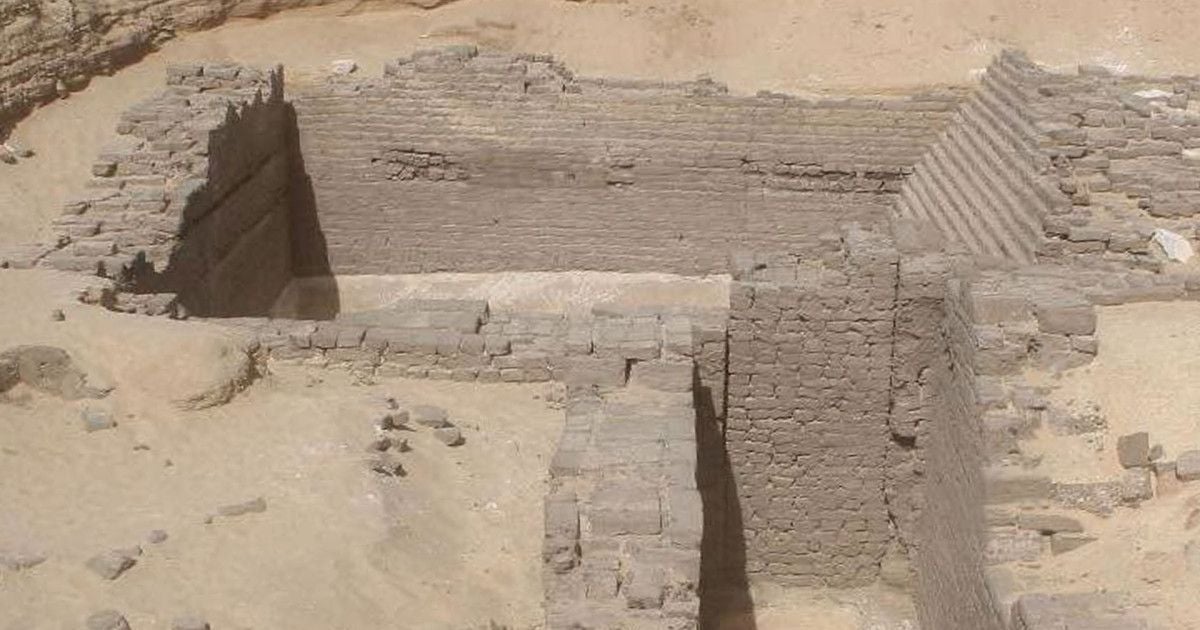
Five thousand years ago, on a limestone rise above the Nile at Gabal El-Teir in Upper Egypt, a builder made a decision that would echo for a thousand years: make the walls thick at the base and thinner toward the top. It sounds obvious now. It was not, not yet. It is one of the earliest known solutions to the problem that would eventually produce Djoser's step pyramid and, after that, Giza.
On 23 June 2026, Egypt's Ministry of Tourism and Antiquities announced the discovery of two monumental tombs at Gabal El-Teir, in the Minya governorate, dating to the early Thinite period (3100 to 2686 BCE). This is roughly five centuries before Djoser, Egypt's first pharaoh-architect, raised the step pyramid at Saqqara. There were no pyramids yet when these tombs were built. There was not even a settled formula for a royal tomb. What there was, evidently, was experimentation.
The first tomb shows walls with deliberately decreasing thickness, thick at the foundation, tapering as they rise: a technique that reduces the overall weight of the structure while improving its stability. Minister Sherif Fathy has linked it directly to solutions that reappear, refined, in Djoser's step pyramid and later in the smooth-faced pyramids of the Fourth Dynasty. Archaeologists also found the remains of wooden supports once used to brace the walls during construction, and evidence that later builders quarried some of the original stone blocks for their own monuments, a routine fate for ancient Egyptian structures.
A second tomb nearby, built to nearly the same plan, survived intact, giving researchers a rare side-by-side comparison of the same design at two different states of preservation.
According to Hisham El-Leithy, secretary general of Egypt's Supreme Council of Antiquities, early analysis shows close similarities to the tomb of King Den, a First Dynasty ruler buried at Abydos and the first king depicted wearing the double crown that united Upper and Lower Egypt. Den's tomb introduced the monumental staircase leading down to the burial chamber, a genuine architectural landmark. The Gabal El-Teir tombs now suggest that this era of innovation was not confined to Abydos.
The wider necropolis, first partially excavated in 2010 under Mustapha al-Bakri, has also produced crouched burials wrapped in decomposed plant-fibre mats, some accompanied by distinctive black-topped pottery associated with the Naqada II and III cultures, and others laid in the fragile remains of wooden coffins. Together, the finds show the site was used continuously from the late Predynastic period through the Thinite era, precisely the window in which Egypt's first royal symbols, including the serekh, the falcon-topped palace facade enclosing a king's name, come into being.
Archaeologists suspect Gabal El-Teir has not finished talking.


