In 1899, Henri Matisse spent money he did not really have on a small, strange painting of three nude women in a blue-and-ochre landscape. He would keep Cezanne's Three Bathers for thirty-seven years, through everything, before giving it to the Petit Palais in 1936. His explanation was almost reverent: this canvas, he wrote, was 'of the first importance' in Cezanne's whole output, the dense, complete resolution of a composition the older painter had worried over for years, in study after study, across collections he would never see reunited.
That obsession, it turns out, was contagious. From 23 September 2026, the Grand Palais in Paris opens 'Cezanne et nous', an exhibition built on a deceptively simple claim: no single motif did more to launch modern art than Cezanne's bathers, endlessly repainted, oddly proportioned, faceless men and women wading through water that seems to dissolve them into the landscape.
The strangeness was the point, even to his contemporaries. In 1891, Emile Bernard described Cezanne's nudes as suggestive creatures adrift in 'an eerie blurred setting', neither mythological nor real. Curator Jean-Remi Touzet puts it more bluntly: Cezanne was not painting a new Poussin. He was painting ideas of bodies. His figures have no faces. They are rendered in the same blues and ochres as Mont Sainte-Victoire behind them, porous to their surroundings, less human forms than ecosystems the light happens to pass through.
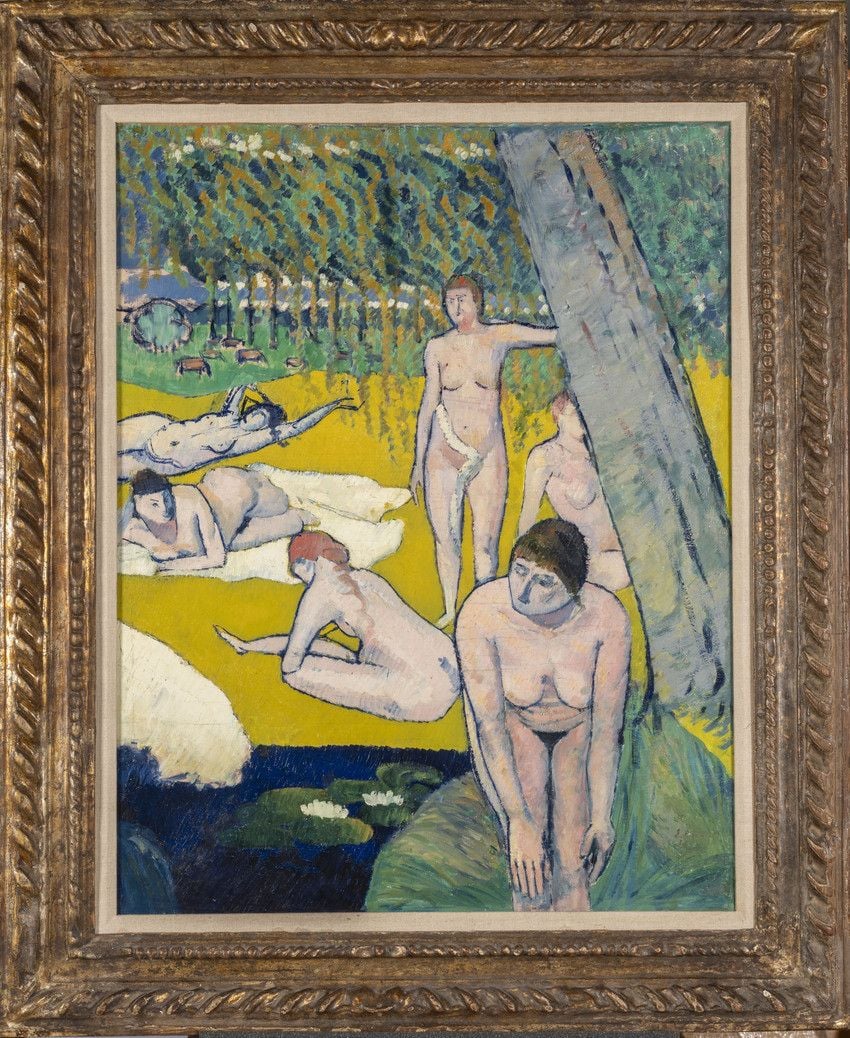
That refusal of anatomical correctness, of what Touzet calls the 'diktats of the Beautiful', gave permission to a whole generation to distort the body on purpose. Emile Bernard outlined his bathers in black and abandoned perspective entirely. Andre Derain carved his 1907 Baigneuses with a palette knife until the figures turned geometric and brutal, bodies seeming to float on an ocean of blue paint. Picasso, deep in the making of his Demoiselles d'Avignon at the time, absorbed the shock of Derain's canvas alongside his own encounter with African sculpture at the Trocadero museum. He would later call Cezanne, without embarrassment, 'the father of us all'.
The paradox the exhibition leans into is that Cezanne was simultaneously the most anti-modern and the most avant-garde painter of his era. He rejected industrial, rational modernity in favour of an imagined golden age of bodies and nature in harmony, and precisely that rejection is what Matisse chased for two decades in his Nu de dos relief series, and what Kazimir Malevich, before he ever touched Suprematism, channelled into his 1911 Bather, a ruddy, disproportionate faun-like figure Malevich could study firsthand in Sergei Shchukin's Moscow collection of French avant-garde painting.
The line does not stop in 1913. Scottish painter Peter Doig's Bathers, based on a 1942 photograph of Robert Mitchum on a Delaware beach, still carry the same unresolved scale between body and landscape, the same sense that the canvas was pulled off the easel before it was finished. Cezanne never really finished his bathers either. Vollard sold the studies as studies because that is what they were: a lifetime of failing, on purpose, to complete the same nine or ten bodies in water, in a way that turned out to be the most generative failure in the history of painting.


