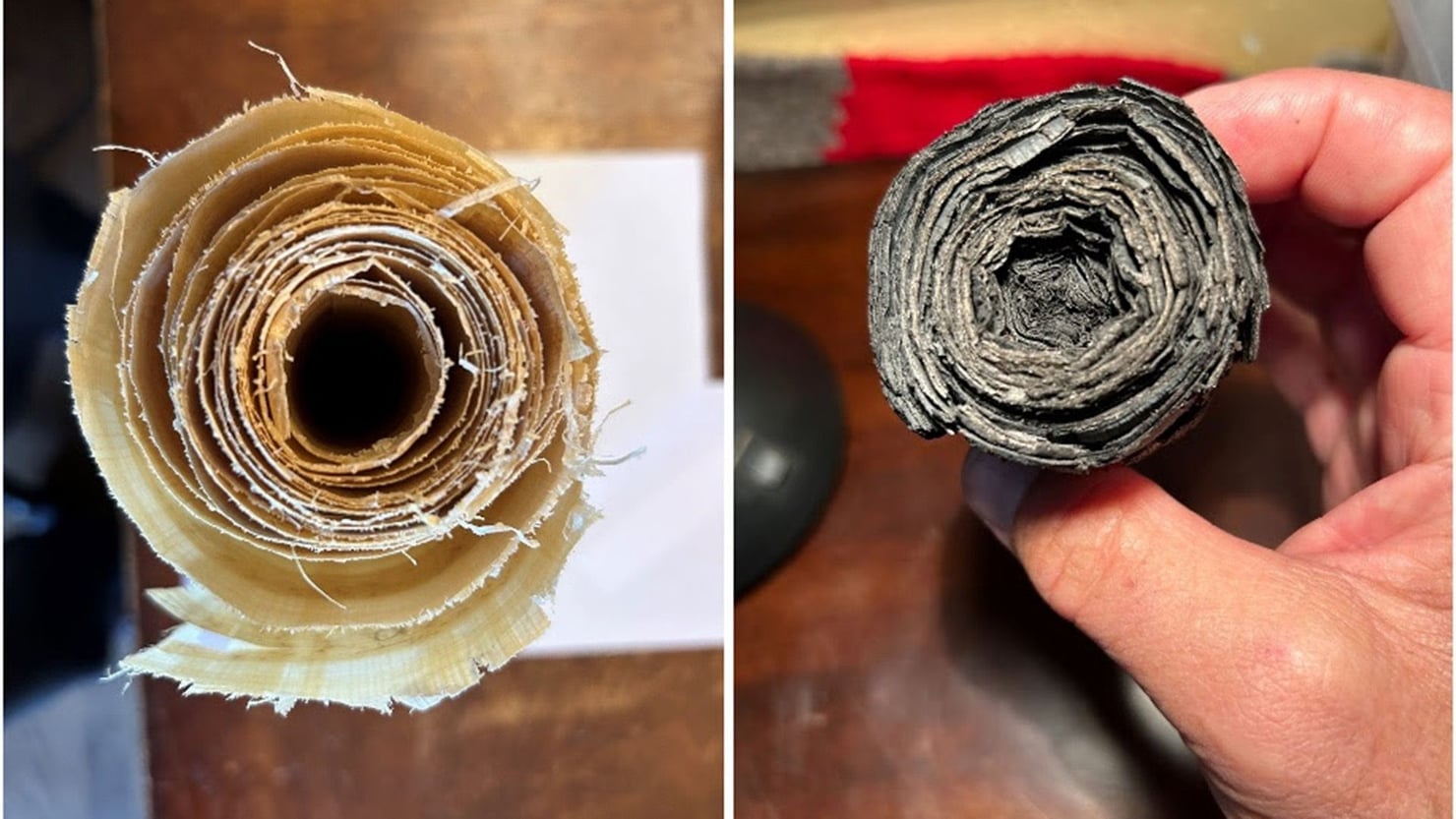
To find writing inside a scroll too fragile to unroll, it helps to know what to look for in a scan. Douglas Seiler, a researcher affiliated with Berkeley SETI, and specialists at the University of California, Berkeley, and the National Institute of Standards and Technology (NIST) tested one possibility: lead in the ink.
The library of Herculaneum’s Villa of the Papyri, discovered in 1752, contains around 1,800 scrolls and fragments. The eruption of Vesuvius in AD 79 charred them, leaving them so fragile that attempts to unroll them can cause them to break apart. Tomography and virtual unrolling have since made it possible to recover parts of some texts without physically opening the papyri.
Reading them remains difficult. Papyrus and inks traditionally used in the ancient world are often both carbon-based, so they can look much alike in a scan. Earlier analyses, however, found traces of lead in letters on some ancient fragments. Because lead produces a clearer signal, it might help distinguish writing from the charred papyrus beneath it.
The team wrote on a modern papyrus scroll using inks with different concentrations of lead, then charred it in a low-oxygen environment to give it an appearance similar to the Herculaneum papyri. X-ray fluorescence detected lead even at the lowest concentration tested. At NIST, tomography reconstructed the scroll’s interior, and software laid its layers out virtually. In one part of the resulting image, some words could be read without further text-recognition algorithms.
The researchers propose using a portable instrument based on X-ray fluorescence to make a preliminary survey of the Herculaneum papyri. Scrolls in which it detects lead could then be selected for synchrotron tomography, which requires specialised facilities but produces more detailed images.
Before that approach can be used across the collection, the team will need a reliable way to examine many artefacts. The modern scrolls offer another test: because their original text is known, they can help researchers assess and improve digital reading methods. Whether the contrast seen in the experiment can reveal new passages in ancient papyri remains to be established by examining the scrolls themselves.


