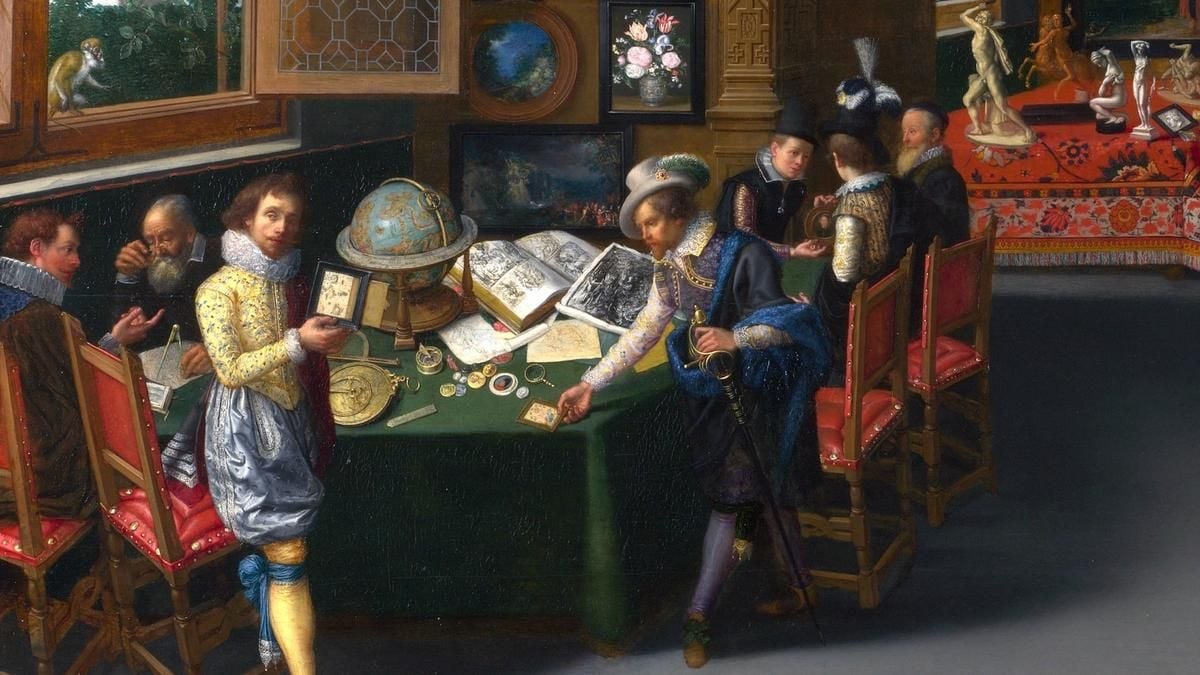
In the Tradescants’ catalogue, pieces of amber containing insects and spiders appear in a chapter devoted to carved, turned, sewn and painted objects. Several kinds of coral appear in the same chapter. These entries offer a glimpse into how a cabinet of curiosities was organised. Collections of this kind spread across Europe in the sixteenth and seventeenth centuries.
In a video for the National Gallery of Art in Washington, DC, essayist Evan Puschak traces the history of these collections. In its introduction to the video, Aeon places them in the context of long-distance trade and European colonial expansion. The Tradescants’ collection shows how those networks supplied individual collectors. Merchants of the English East India Company acquired some of the Asian objects that the family kept at their home in Lambeth, London.
In 1656, John Tradescant the Younger published the Musaeum Tradescantianum, a catalogue of the collection he had built with his father. In the introduction, he distinguished natural specimens, such as animals, plants and minerals, from objects made by people, such as clothing, utensils and weapons. The amber and coral listed among the artefacts show how readily that distinction could blur in practice.
The antiquary Elias Ashmole acquired the collection and donated it to the University of Oxford. When the Ashmolean opened to the public in 1683, the objects from the Tradescants’ home formed part of its holdings alongside an existing university collection. Nearly two centuries later, in 1860, the natural history specimens still held by the Ashmolean helped form the collection of a new university museum devoted to natural history.