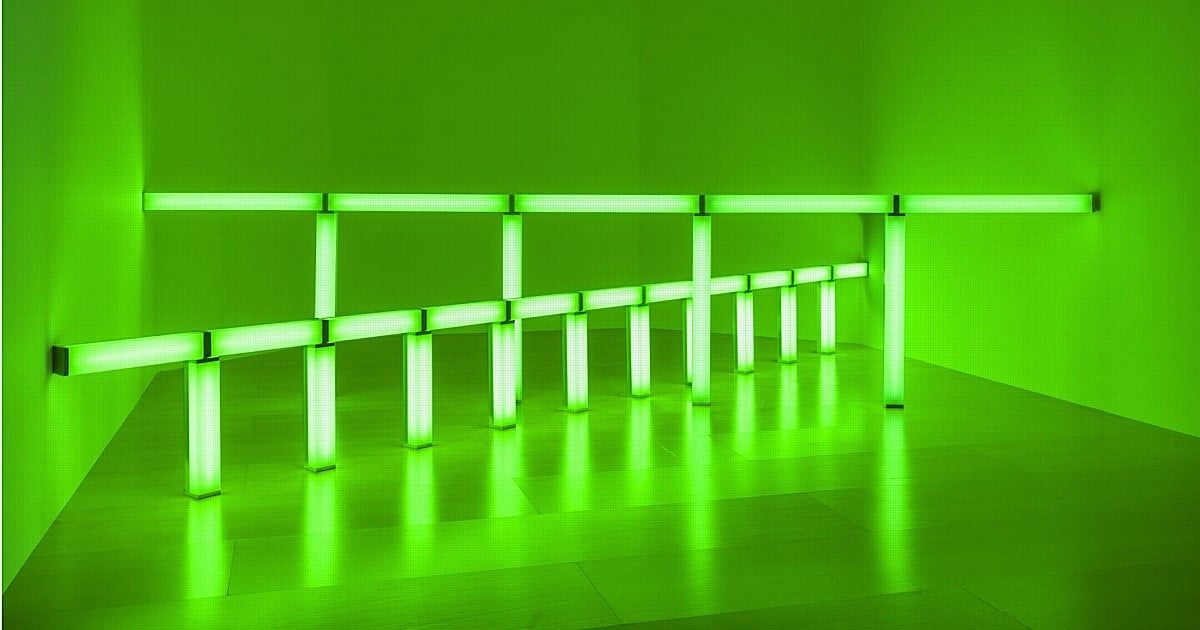
At the Guggenheim Museum Bilbao, a structure made of green fluorescent tubes blocks the entrance to a gallery. Made in 1966, greens crossing greens (to Piet Mondrian who lacked green) was Flavin’s first barrier work. Plexiglas covers soften and diffuse the green light.
Flavin began working with electric light in the early 1960s. He used commercially available fluorescent tubes, arranging them along walls and across floors. In later installations, he began working with corners, barriers and corridors. He called these arrangements “situations” because he conceived them in relation to the spaces where they would be installed.
The green barrier is one of more than twenty works in Dan Flavin: Some Light, on view from 11 November 2026 to 4 April 2027. The exhibition brings together works from the Panza Collection at the Guggenheim in New York and loans from Dia Art Foundation.
Fluorescent tubes have a limited lifespan, and the museum keeps replacements on hand. At the exhibition’s press preview, curator Lauren Hinkson warned that these tubes would eventually go out of production, the news agency EFE reported. Once the spares run out, Hinkson said, the question will be whether Flavin’s installations can continue to exist in another form.