In a case in the Doge's Apartment, inside the Palazzo Ducale in Venice, stands a small bronze horse that looks like the miniature ancestor of the Horse and Rider figures Marino Marini would carve from 1936, twenty-five centuries later. It is among the smallest objects in an exhibition that opens with something far louder: the San Casciano bronzes, votive statuettes and anatomical ex-votos that surfaced from the mud from 2019 onwards at one of the most significant thermal complexes of antiquity, and that have contributed to the recent surge of 'Etruscomania'.
Those bronzes, though, are one piece rather than the whole picture. 'Etruscans and Veneti. Waters, Cults and Sanctuaries', at the Palazzo Ducale until 29 September and restaged this autumn at the Fondazione Luigi Rovati in Milan, is about ancient Italy's relationship with the sacredness of water, and in particular about two neighbouring peoples.
In the first millennium BC the Etruscans took cultural and commercial supremacy over much of the peninsula, with one exception: the territory of the Veneti in the north-east. Contact and cross-influence were inevitable. Yet on several crucial aspects of life, religion and social structure, as the research behind the exhibition shows, the two peoples always kept their independence.
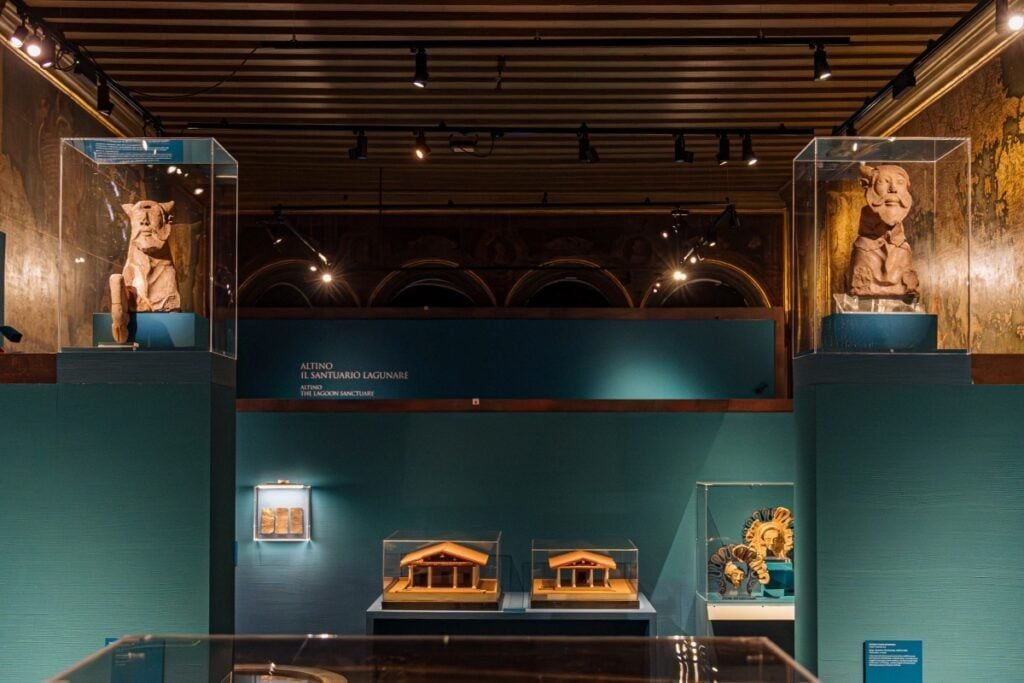
The thread the show follows is water: healing springs and thermal sites, which both cultures treated as thresholds to the divine, places of cure and at the same time engines of exchange, commercial as much as cultural. Hence the itinerary. The sacred curative springs of Etruria, from Vulci to Chiusi and Chianciano and on to San Casciano dei Bagni; the Fontile sanctuary at Marzabotto, already in the Po plain; and on the Venetic side Montegrotto, San Pietro Montagnon and Lagole di Calalzo. Then the sanctuaries tied to sea and river ports, from Pyrgi to Spina and Adria, and finally Este and Altino, the site closest to Venice.
The opening rooms are Etruscan, and the quality shows: stone and bronze sculpture of real refinement, of which the Head of Leucothea from Pyrgi is only one example, alongside decorated vases and fine objects of everyday use. Where possible, each section tries to rebuild the setting those objects once stood in, or the one in which they were found.
Moving north, the points of contact start to appear. The Veneti, Giuseppe Sassatelli notes in the catalogue, knew the civilisation of central Italy very well, admired Etruscan craftsmanship and watched its fashions and way of life closely. They did not, however, take it up wholesale, except in certain respects. Their sacred practices were bound to water too, but their local gods are rendered more faintly than those of their neighbours, who were far more given to religious cult and to monumental sanctuaries, entirely absent in Venetic territory. Their own genius went elsewhere: the art of the situla, the decorated bronze vessel, and horses. Like the one in the case.
The comparison between the two peoples' artistic capacities is, it must be said, unforgiving: the Etruscans elegant and lifelike, the Veneti plain and elementary. But the exhibition is not keeping score. Its point is that two peoples can share the same instinct towards water, watch each other for centuries, trade, admire, and still remain two different things.


