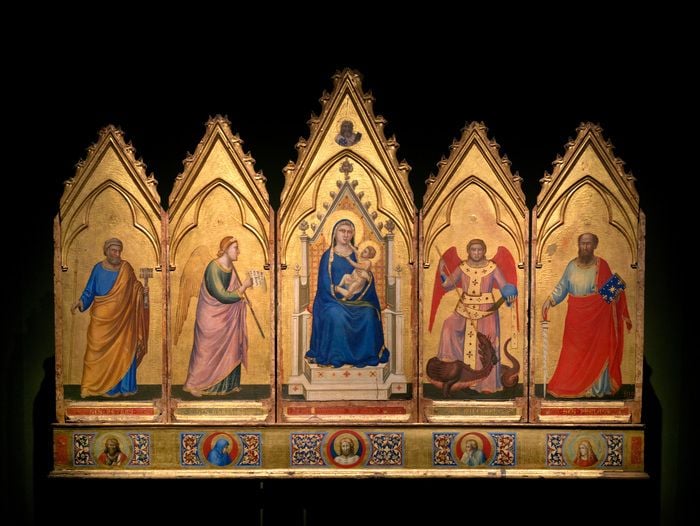
In the Bologna Polyptych, the Christ Child touches his mother’s chin and clutches the neckline of her robe. The Madonna sits on a throne of pale marble. On its lowest step is the inscription ‘OPUS MAGISTRI IOCTI DE FLORENTIA’, meaning ‘the work of Master Giotto of Florence’.
Painted by Giotto and his workshop around 1330, the polyptych is, according to Italy’s Ministry of Culture, the only surviving work to bear witness to his activity in Bologna. It went back on display on 18 November 2026 after a loan to the Sacred Art Festival in Iași, Romania. Work on the Giotto gallery and the adjoining rooms had begun in September.
The design of Leone Pancaldi, who remodelled the Pinacoteca in the 1950s and 1960s, is still visible in the Giotto gallery. His upright display structures and label holders remain in place, while the museum has updated the gallery texts. Alongside the polyptych are Andrea di Bartolo’s Last Supper and Lorenzo Monaco’s Madonna and Child Enthroned with Angels.
The Corridor of the Early Masters displays Vitale da Bologna’s Saint George and the Dragon and works by Simone dei Crocifissi. In the section devoted to Bolognese polyptychs, the Pinacoteca displays Jacopo di Paolo’s Crucifixion between two panels depicting saints. Similarities identified during conservation suggest that the three panels once belonged to the same altarpiece.
In the Giotto gallery, the Pinacoteca has redesigned the lighting and adjusted how daylight is filtered to bring out the polyptych’s colours and gilding. Look closely at the step of the throne and you can see the five words in gold that form Giotto’s signature.
- Pinacoteca Nazionale di Bologna (Ministero della Cultura)
- Pinacoteca Nazionale di Bologna, scheda dell’opera “Polittico”
- Pinacoteca Nazionale di Bologna, “Sala 3: Giotto e i ‘Forestieri a Bologna’”
- Pinacoteca Nazionale di Bologna, scheda “Crocifissione di Cristo”
- Pinacoteca Nazionale di Bologna, scheda/autori Jacopo di Paolo
- exibart.com
- Pinacoteca Nazionale di Bologna, Ministero della Cultura