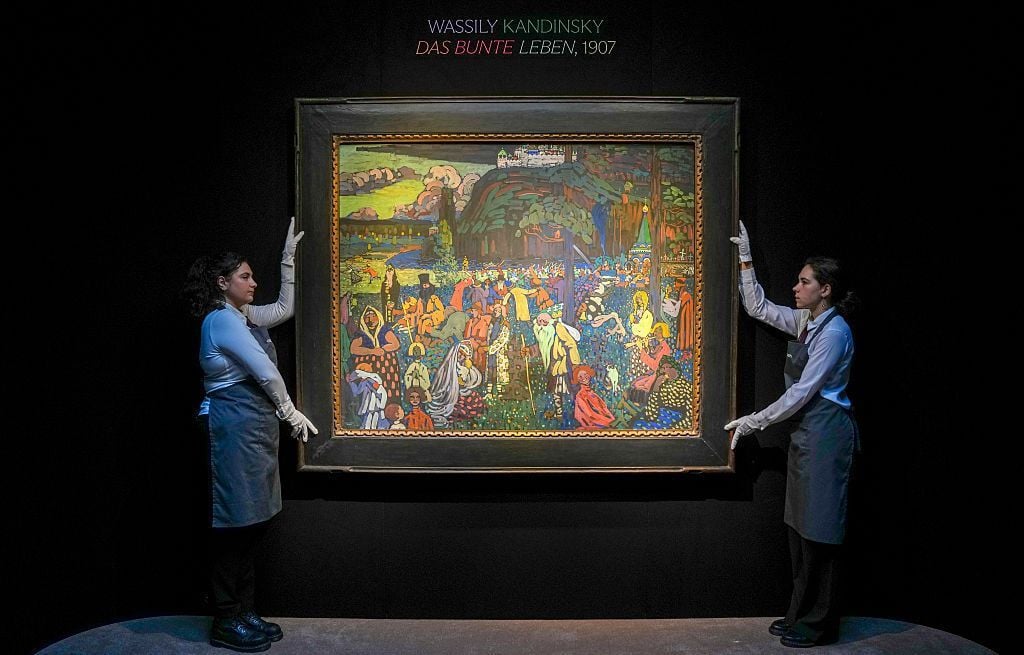
In Das bunte Leben, riders, monks and lovers share a crowded landscape, while a funeral procession moves in the distance. Kandinsky painted the scene in 1907, during a stay in Paris with the painter Gabriele Münter. Partly inspired by Russian folklore, the canvas predates his move towards abstraction.
On 14 October 2026, the painting sold at Christie’s in London for £31.56 million, approximately $42 million. It was offered by the heirs of Hedwig Lewenstein-Weyermann, to whom it had been returned three years earlier.
The work entered the collection of Emanuel and Hedwig Lewenstein, a Jewish couple living in Amsterdam, in 1927. After Emanuel’s death, Hedwig lent it to the Stedelijk Museum. It left the museum in September 1940, during the Nazi occupation. A month later, it was sold at auction to the collector Salomon B. Slijper for 250 Dutch guilders.
After the war, the family made repeated attempts to trace the painting but received insufficient information. The German advisory commission that later examined the case found, in particular, that the Stedelijk had given the Lewensteins less information than it possessed. Meanwhile, Bayerische Landesbank bought the painting in 1972 and lent it to the Lenbachhaus in Munich.
The circumstances of the 1940 auction were central to the restitution claim. Who had arranged the sale, and who had received the proceeds? The commission could establish neither, but concluded that the available evidence did not support the view that the sale had been voluntary. Numerous indications that the loss was linked to Nazi persecution led it to recommend restitution in May 2023. The painting was returned to the heirs the following month.
- Commissione consultiva tedesca — Raccomandazione Lewenstein / Bayerische Landesbank
- Christie’s — Risultati delle Evening Sales di Londra, ottobre 2026
- Christie’s — Comunicato del 22 ottobre 2026 con riscontro del controvalore in dollari
- Christie’s — Scheda del lotto Das bunte Leben
- Christie’s — Comunicato di presentazione dell’opera
- Christie’s — Pagina sul dipinto e sul soggiorno parigino
- Smithsonian Magazine — Looted by Nazis and Recently Restituted, a Kaleidoscopic Kandinsky Painting Just Sold for Nearly $42 Million
- Christie’s, pagina sul dipinto
- Christie’s