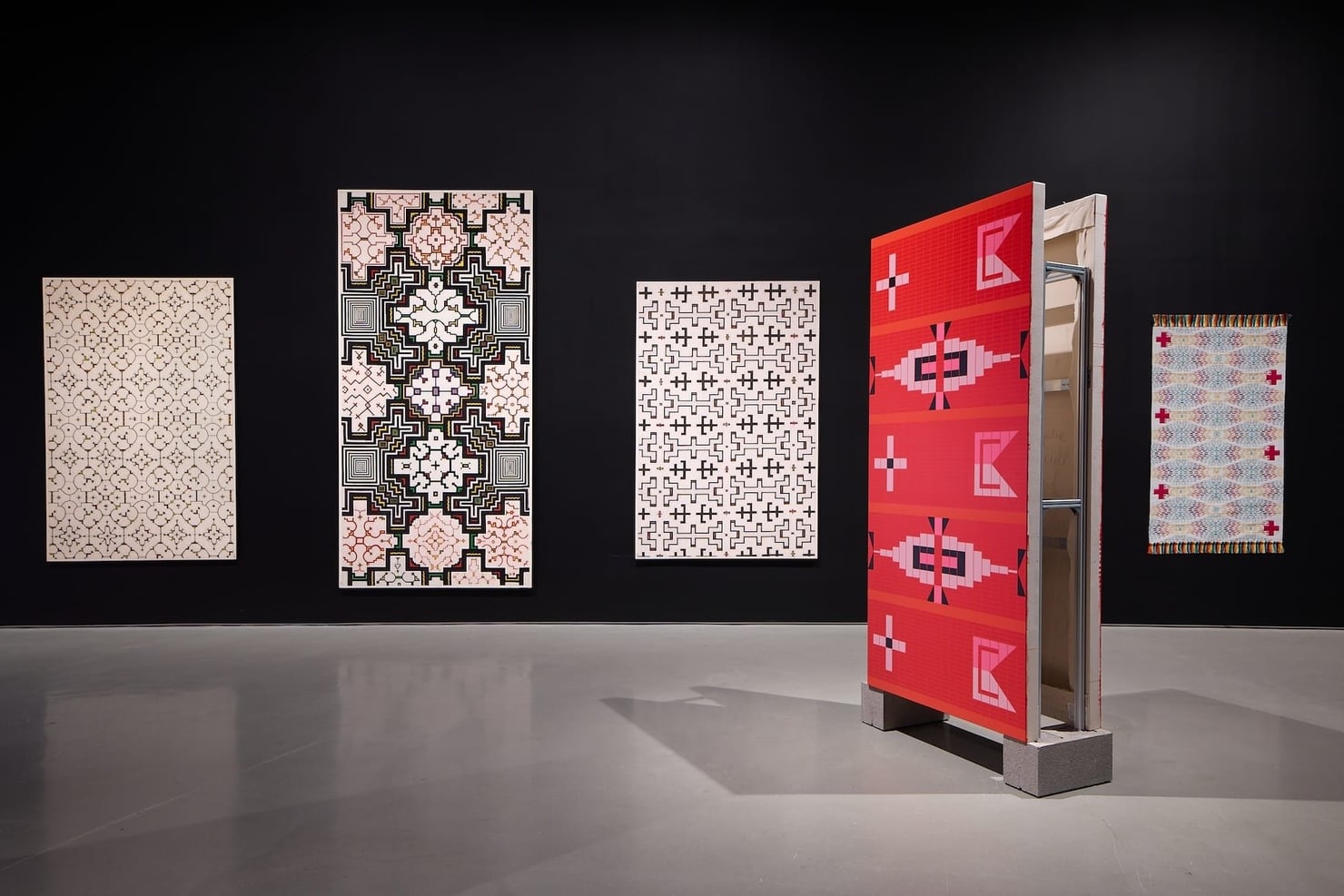
Melissa Cody’s Sunrise Rainbows (2025) is a Jacquard weave with dyed wool fringe. A fourth-generation Navajo, or Diné, weaver, Cody works with both a traditional upright loom and a mechanised Jacquard loom. She recomposes inherited patterns through layered geometry and her own combinations of colour.
Curated by Noor Alé, Radiant Geometries: Vectors of Knowledge from the Indigenous Americas is at Rice University’s Moody Center for the Arts in Houston until 19 December 2026. It brings together contemporary Indigenous and Latin American artists whose work engages with mathematics, architecture and the natural world. The exhibition considers how knowledge passed down over time is reworked by individual artists.
The family teachings that inform Cody’s work sit alongside other ways of holding and passing on knowledge. Eamon Ore-Giron also draws on objects kept in collections. For the exhibition, he has made new paintings inspired by Maya ceramics at Rice University. They form part of a painting practice that brings references to Indigenous arts of the Americas into conversation with twentieth-century geometric abstraction.
Natalia Montoya Lecaros brings references to Aymara clothing and ceremonial practices into sculpture. The four figures of Tótems de emergencia combine painted panels, yarn, beads and feathers. Freestanding and arranged in a circle, they resemble participants in a dance. Rice University describes the work as evoking a ceremonial dance associated with agricultural cycles.
The sculptures’ circular arrangement thus echoes a ceremonial practice tied to agricultural cycles.