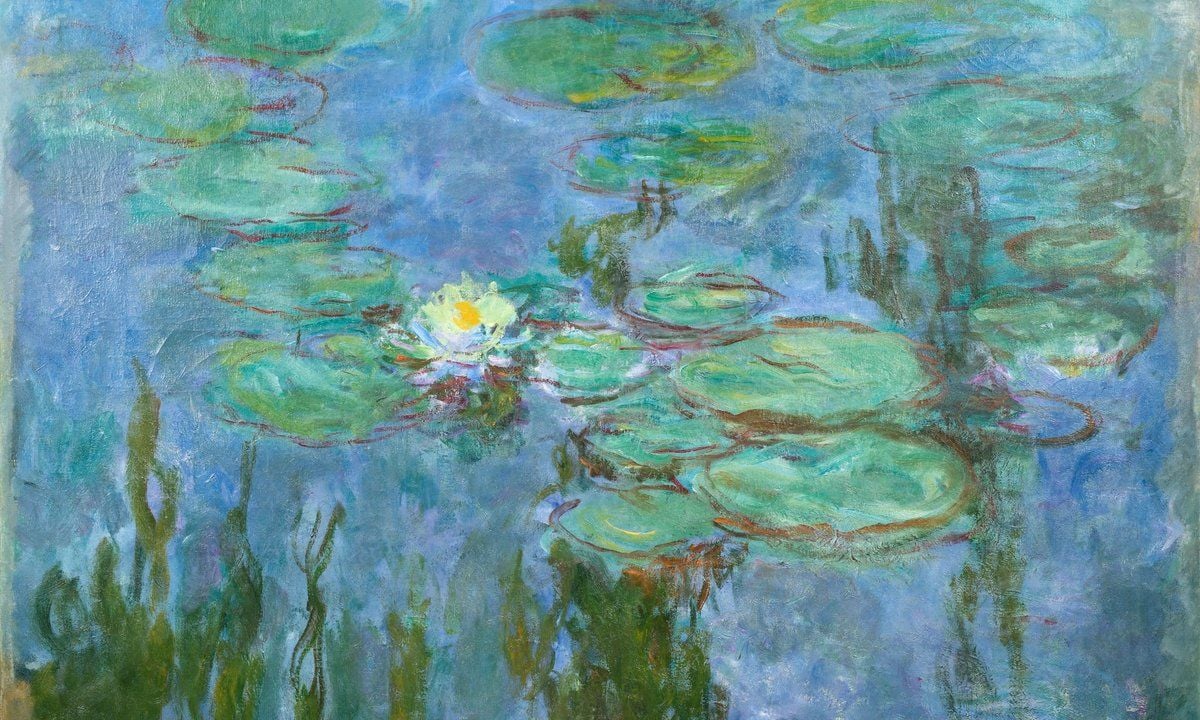
From 25 February to 27 June 2027, Tate Modern will present Monet: Painting Time, organised with the Musée de l’Orangerie and focused on the relationship between painting and the passage of time. The exhibition brings together works connected with railways, grain stacks, cathedrals and water lilies, but links them through one question: how does vision change when time becomes part of the image?
The exhibition develops three ways of reading this relationship. One concerns the acceleration of modern life, associated with railways and industrialisation. Another looks at the repeated observation of the same subject. A third turns to the slower cycles of nature and the seasons.
Arrival of the Normandy Train, Gare Saint-Lazare, painted in 1877, is one example. Here modernity enters the painting through movement, steam and changing perception. In the Rouen Cathedral series, by contrast, returning to the same subject makes variations in light, atmosphere and duration visible.
The exhibition also includes The Seine at Port-Villez from 1894, a work undergoing conservation. The removal of later layers of yellowed varnish offers another way of thinking about time: not only as something represented in the image, but as something that acts materially on the painting itself.
The exhibition therefore brings together different forms of time: the speed of modernity, repeated observation, natural cycles and conservation. Rather than presenting Monet chronologically, it uses time as a way of reading his work.


