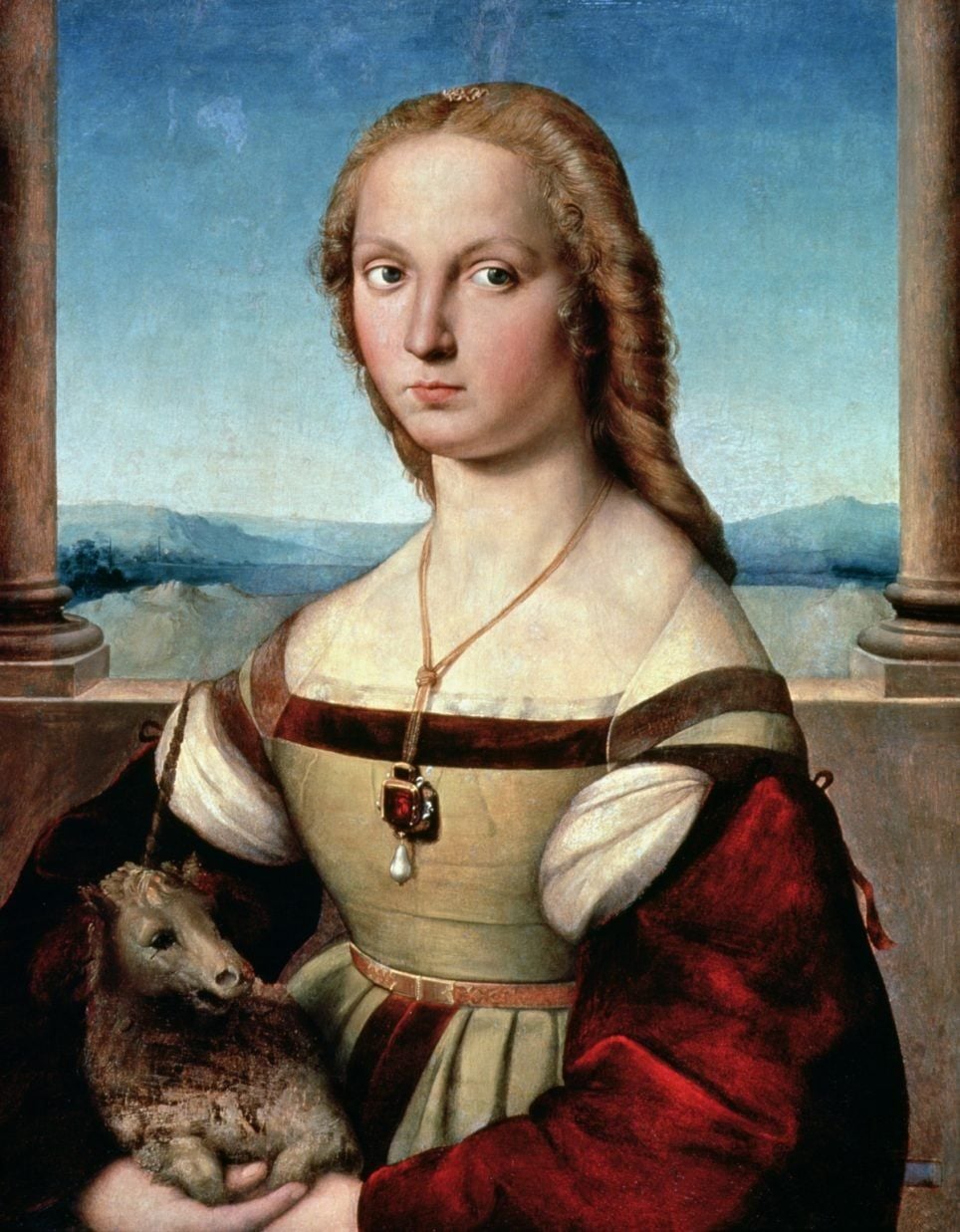
Look closely at the Borghese Gallery's most beguiling portrait and you will notice the unicorn sits a little oddly in her arms, as if it does not quite belong there. It does not. Beneath it, X-rays taken in 1959 revealed a small dog, painted first by Raphael, then painted over.
A dog meant fidelity. A unicorn, in medieval legend, meant something far more exacting: purity so absolute that only a virgin could tame the creature. Somewhere between the first brushstroke and the last, Raphael changed his mind about what kind of woman he was painting, or what kind of claim he wanted to make about her. The dog was too damaged beneath the paint layers to be safely uncovered, so restorers left the unicorn as the visible truth. The dog remains the painting's buried first draft.
This is not the only secret the panel has kept. For centuries, the woman in the picture, painted around 1505 to 1506 by Raffaello Sanzio da Urbino, was believed to be Saint Catherine of Alexandria: her attributes, the toothed wheel of her martyrdom and a palm frond, seemed to confirm it. The painting itself was long attributed to other hands, Perugino among them. Then a restoration in 1934 and 1935 stripped away the overpainted saintly emblems and revealed the unicorn beneath, exactly as the dog would later be revealed beneath that. The find backed up a theory the art historian Roberto Longhi had already proposed: this was Raphael's own work, not a follower's.
But solving the authorship only opened a second mystery, one that has never closed. Who was she?
One candidate is Maddalena Strozzi, the young wife of a wealthy Florentine merchant, whom Raphael painted at roughly the same moment. Anna Coliva, art historian and former director of the Borghese Gallery, finds this the most convincing case, pointing to the strikingly similar puffed red sleeves worn by the sitter in another Raphael portrait, La Donna Gravida, now in the Palazzo Pitti in Florence: the same fabric, arguably the same woman, painted twice.
A second, more novelistic theory names Laura Orsini, daughter of Giulia Farnese, the celebrated mistress of Pope Alexander VI. The American art historian Linda Wolk-Simon argued this case in 2015, curating an exhibition devoted to the painting in the United States. In her reading, the teenager sat for Raphael just before her marriage in late 1505 to Nicola Franciotti della Rovere, nephew of Pope Julius II, which would explain the sumptuous necklace at her throat: a wedding gift, caught mid-negotiation with eternity.
A third camp declines to choose at all, preferring to see an anonymous young Roman aristocrat who was never meant to be named.
Perhaps that reticence is the real subject. Raphael changed the animal in her arms once already; he may never have intended the woman herself to be pinned down. In the Florentine Renaissance that shaped him, from Leonardo onward, a portrait like this one was not always a record of a particular face. Sometimes it was an argument about harmony itself, wearing a face as a kind of disguise.
As reported by Beaux Arts, the identity question remains formally unresolved. The unicorn keeps its secret. So, somewhere underneath it, does the dog.


