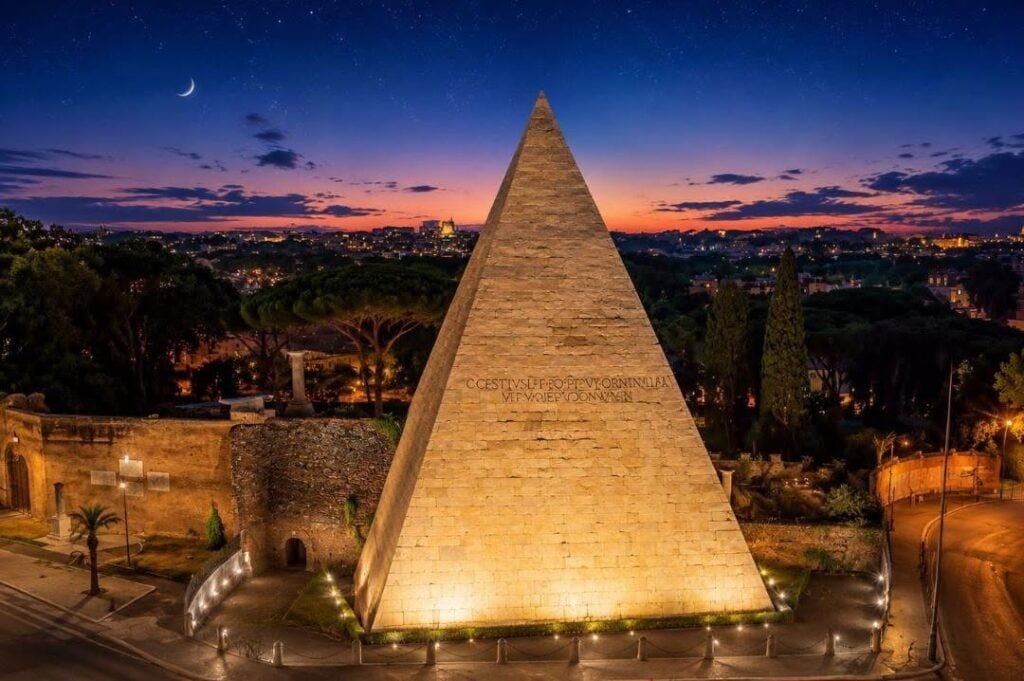
For forty-five minutes, after sunset, visitors can walk into a 2,000-year-old tomb lit up like a stage set. That is the offer Rome is making, for free, every Friday evening from 4 September to 31 October 2026, at the Pyramid of Cestius, the marble tomb that has stood beside via Ostiense since around 12 BC.
The reopening closes a loop that began in 2013, when Japanese businessman Yuzo Yagi, struck by the pyramid's beauty and by how badly it was decaying, gave the Soprintendenza Capitolina one million euros to restore its marble cladding. That restoration reopened the monument to the public in 2015, with then mayor Ignazio Marino cutting the ribbon alongside Yagi himself. A decade on, the pyramid needed help again: three years of closure and a fresh restoration, this time paid for through Italy's PNRR Caput Mundi programme ahead of the 2025 Jubilee, have given it an entirely new lighting system, inside the funerary chamber and out, designed to make its Third Pompeian Style wall paintings and its stark geometry legible after dark.
The numbers behind the shape are worth pausing on. Built in just 330 days to satisfy the will of Gaius Cestius, one of Emperor Augustus's seven priests, the pyramid rises 36.4 metres from a base 29.5 metres square, faced in Lunense marble over a concrete core, a Roman engineering trick that let it stand taller and steeper than the Egyptian pyramids it was imitating. Rome once had at least three such structures, built in the decorating craze that followed Egypt's fall to Augustus in 31 BC. This is the only one left. Another, near via della Conciliazione, was demolished in 1499 on the orders of Pope Alexander VI, clearing ground for his own Jubilee.
Accessibility improvements, new pathways, refreshed information panels and even better-organised quarters for the resident colony of stray cats round out the works. 'We followed one precise principle,' says Barbara Rossi, the official responsible for the site, as reported by Artribune: 'improve every aspect of the visit while respecting the monument's identity.'
Booking is required and slots are limited. What is not limited is the strangeness of the offer itself: a Roman emperor's priest, buried inside an Egyptian fantasy financed by his own will, now lit for free viewing thanks to a Japanese donor's affection and an EU recovery fund built for an entirely different crisis.


