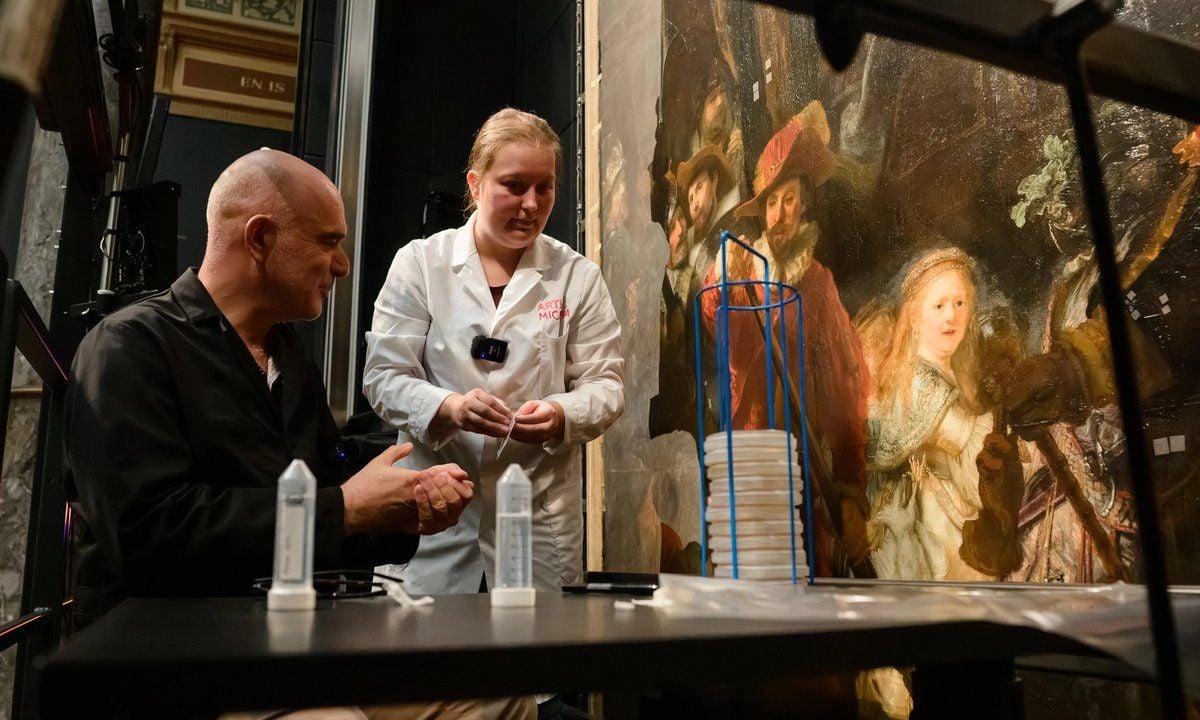
Behind a glass wall at the Rijksmuseum in Amsterdam, a laboratory technician from Artis-Micropia and restorers from the Rijksmuseum are sampling Rembrandt’s The Night Watch. Over six months, they will collect material from areas with and without varnish. The samples are put into culture at Micropia and then identified by an external laboratory. The subject is not only bacteria, but micro-organisms more broadly.
The work is connected to Operation Night Watch, which the Rijksmuseum began in 2019. From 11 November, visitors will be able to see the first results in The Night Watch Lives, an installation built around a life-sized reproduction of the painting. The installation will continue to develop as further samples are taken. It will show where different micro-organisms were found.
Katrien Keune, head of science at the Rijksmuseum, says the project began with a question about contact. People constantly release biological material into the spaces they occupy through movement, speech and breathing. The research asks whether traces of visitors who stand before The Night Watch can also be detected on its surface.
Keune describes finding bacteria from Rembrandt himself as an ideal discovery, but no such result has been reported. The project instead connects the material history of the painting with the conditions of its public life. It also examines what can be learned while limiting intervention to sampling and the gentle maintenance the work receives. Deep cleaning is carried out only about once every 50 years.
Earlier Rijksmuseum research described Rembrandt’s use of a lead-rich oil substance beneath the paint, rather than the glue layer used by many of his seventeenth-century contemporaries. In Amsterdam’s damp buildings, this may have helped limit microbial growth.
Eline van Bloois, a microbiologist at Artis-Micropia, stresses that micro-organisms are not inherently harmful or beneficial. Only a small fraction are thought to cause illness in humans or animals, and in some cases exposure can help train the immune system. On The Night Watch, invisible life is being studied as part of the painting’s materials, environment and public use.


