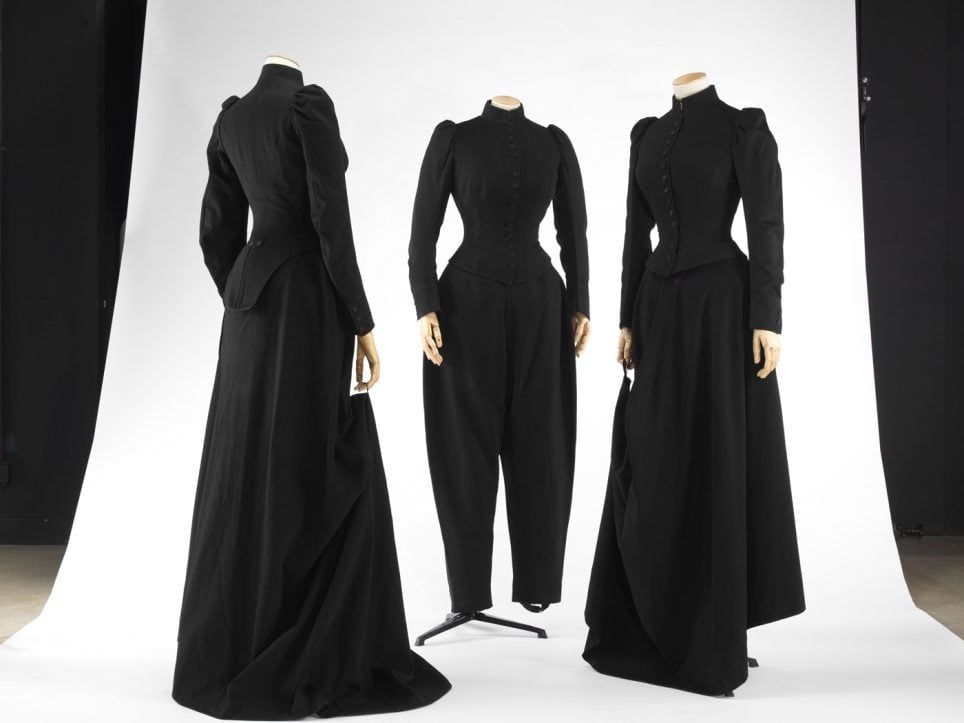
Among the objects on display are Princess Murat’s riding breeches. Reinforcements sewn inside along the thighs suggest that she rode astride rather than sidesaddle. They date from a later period than the exhibition’s mainly nineteenth-century collection, but introduce one of its central themes: the relationship between clothing, movement and what a person could do.
The question is not simply whether women wore trousers, but what those clothes made possible.
Riding was one of the first activities in which some women encountered the methods of men’s tailoring. Curator Marine Kisiel explains that women riders were an exception to the usual division between dressmakers, who clothed women, and tailors, who clothed men. Their riding clothes used cuts, materials and padding associated with menswear. Worn beneath skirts, trousers served a practical purpose: they allowed women to ride differently.
As cycling spread, clothes that might once have remained hidden became more visible. Some women adopted bloomers, loose trousers that made pedalling easier. Their visibility drew criticism and caricature because they challenged the conventional separation between women’s and men’s dress. The exhibition also shows that cycling clothes did not mean the same thing to everyone: they could be a practical solution, but also a way of presenting oneself in public.
The same relationship between function and appearance emerges in workwear. The exhibition includes clothes belonging to Juliette Caron, described as France’s first woman carpenter, including a smock and loose trousers.
For the painter Rosa Bonheur, clothing met the practical demands of her profession and helped shape her public image. Kisiel says Bonheur requested permission to wear men’s clothes, arguing that they were her workwear. Garments preserved at the Château de By, together with purchase records, now offer a way to study her wardrobe without relying solely on portraits.
Towards the end of the century, women’s tailored suits also accompanied their entry into universities and professions traditionally associated with men. Fashion magazines sometimes sought to soften the look by suggesting the addition of a skirt.
The exhibition ends with clothing as a form of self-representation. Collars, ties and portraits show how dress could do more than make certain activities possible: it could also help women define their presence in public life.


