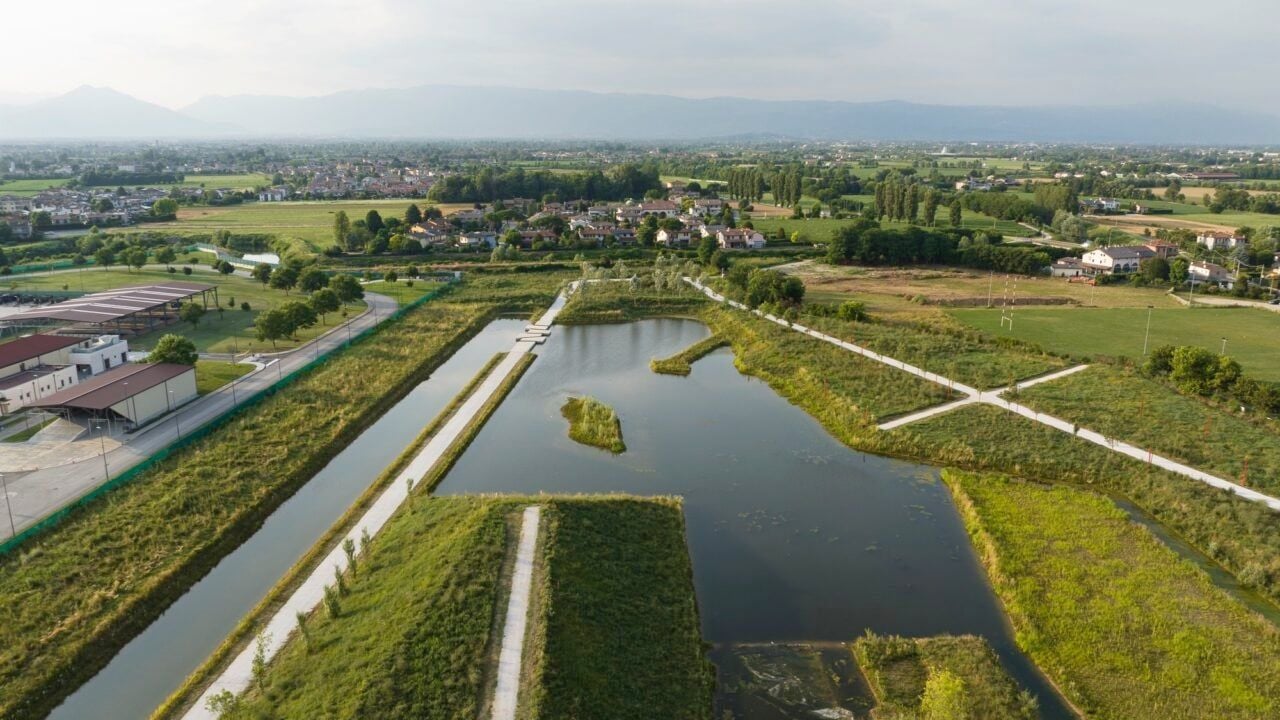
For many years, north of Vicenza, a flat area of more than 600,000 square metres was occupied by the runways and structures of Dal Molin airport. Today, that same space contains canals, lakes, wetlands, woodland and more than eight kilometres of paths.
The transformation gave rise to Parco della Pace, a public area where recreational and cultural activities coexist with a complex environmental system. The water that runs through the park is not decorative: it contributes to the city’s flood safety and creates the conditions needed for new habitats to develop.
The project is one of five finalists for the 2026 European Prize for Urban Public Space, promoted by the Centre de Cultura Contemporània de Barcelona. It was selected, alongside projects in Antwerp, Barcelona, Logroño and Matosinhos, from 381 entries submitted by 38 countries. The winning project will be announced in Barcelona on 15 October, following the public presentation of the finalists scheduled for the previous day.
The nomination recognises a particular way of understanding public space. The park was not designed as a green area placed where the airport once stood, but as infrastructure capable of performing several functions at the same time.
To alter the flat morphology of the site, around 240,000 cubic metres of soil were moved. The excavation made it possible to build a network of canals, basins and wetlands inspired in part by the traditional irrigation systems of the Vicenza countryside. Together, these spaces form an attenuation basin capable of collecting and gradually releasing up to 100,000 cubic metres of water, helping to reduce the effects of more intense weather events.
The same water network that protects the area also provides a suitable environment for plants and animals. In the wetlands, canals and lakes, 62,000 aquatic plants have been planted; 12.5 hectares are given over to woodland. The return of waterbirds, amphibians, fish and other species indicates that the park has already begun to function as an ecosystem, as well as a space designed for people.
Not all the vegetation, however, follows the same process. Some areas were planted according to a precise design; in others, local species were left to grow spontaneously. The project therefore establishes conditions and directions, but does not claim to control every transformation. Water, vegetation and wildlife will continue to change the park over the years.
This choice calls for a form of design less tied to the immediate image of the final result. A living park never presents itself as a finished work: trees and shrubs grow, plant communities change, animals occupy new spaces, and water periodically redraws the relationship between dry and wet areas.
The former airport buildings also play a part in the area’s new organisation. Reclaimed for cultural, educational and recreational activities, they preserve part of the site’s history without forcing it to remain tied to its previous function. Pedestrian and cycle routes, with footbridges, fords and permeable surfaces, cross different environments and allow people to observe the system at close quarters.
The landscape and environmental project was developed by Martí Franch Batllori, EMF, Studio Franco Zagari, ITS Engineering Company and PAN Associati. In the design team’s description, the park is conceived as a new connecting element between the historic city, neighbouring municipalities and the wider territory.
Before reaching the final of the European Prize for Urban Public Space, Parco della Pace received the first prize in June 2026 at the European Garden Award, in the category dedicated to climate adaptation measures in parks and gardens. The award highlighted precisely the coexistence of public experience, natural processes and a response to the effects of climate change.
The transformation of the former airport shows that a public space can accommodate everyday activities while also carrying out environmental work that often remains unseen. As people walk, cycle or take part in an activity, the ground absorbs water, the basins regulate its flow, and habitats continue to form.
The value of Parco della Pace also lies in this overlap. Flood safety is not separate from the quality of the landscape; biodiversity is not confined to an area removed from the city; the reclaimed buildings do not become immobile records of the past. Each element contributes to the way the whole system functions.
Where the airport once required a uniform surface free of obstacles, the park introduces differences: higher and lower ground, water and woodland, planned spaces and areas left to evolve spontaneously. It does not simply erase the previous infrastructure. It transforms a place built to separate itself from the city into a territory that becomes part of it again.


