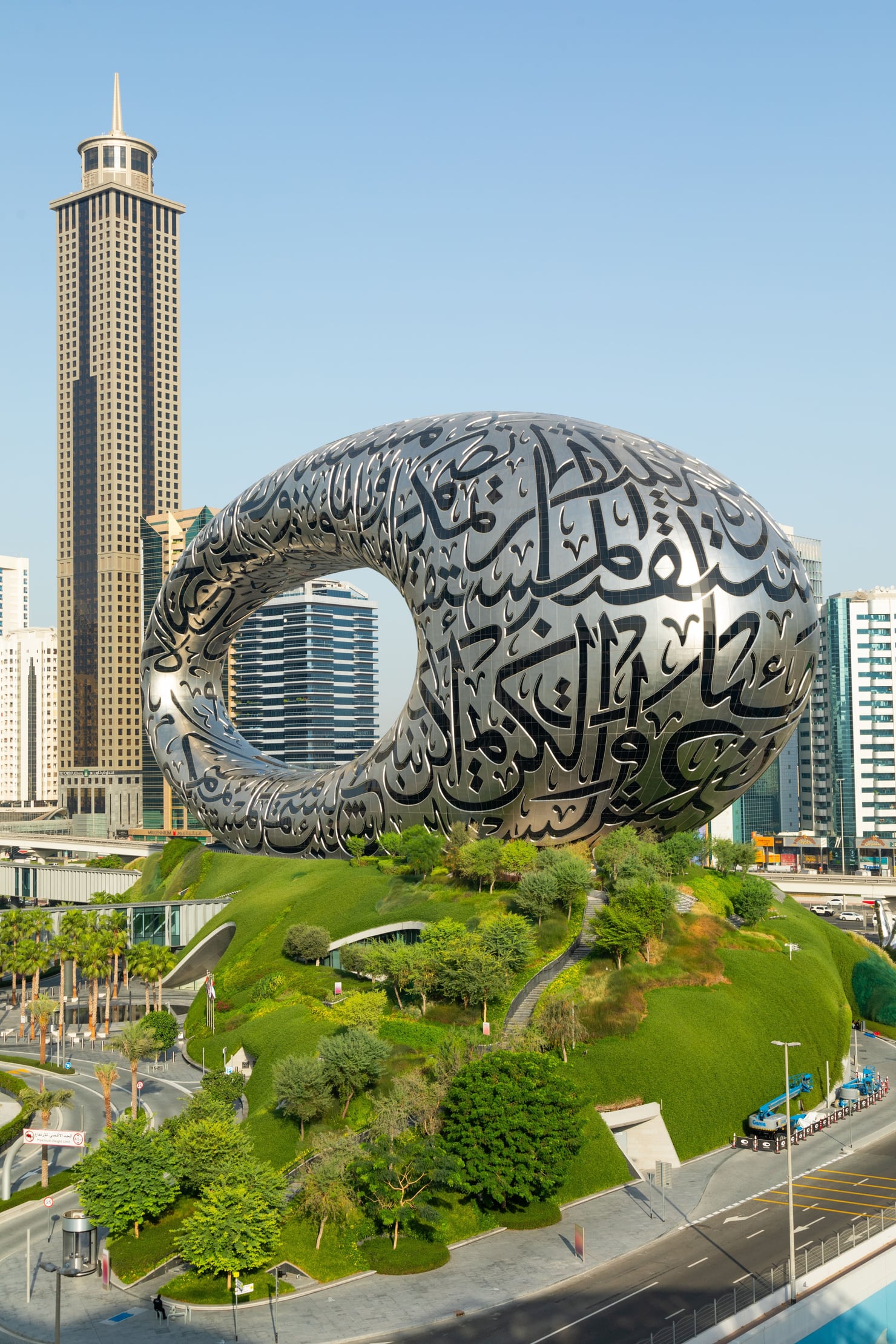
Beside Sheikh Zayed Road in Dubai, a structure with silver reflections rises from a green hill. Its curved surface unfolds around a large central void, while broad Arabic letters cross the façade and allow light to pass through. At the Museum of the Future, words are not applied to the building as decoration. They form its openings and help define its identity.
The design gives a specific meaning to the three main elements of the architecture. The planted hill represents the Earth, its solidity and its connection with place and history. The circular form rising from the hill represents humanity and its capacity to create. The central void points to what we do not yet know: an unwritten future towards which research and innovation are directed.
The same idea runs through the inscriptions on the façade. They present three thoughts by Sheikh Mohammed bin Rashid Al Maktoum, Vice President and Prime Minister of the United Arab Emirates and Ruler of Dubai. The phrases suggest that creativity can outlast the life of its creator; that the future should not simply be awaited, but imagined, designed and built; and that innovation is a condition for renewing life and advancing society.
The words were shaped by Emirati artist Mattar bin Lahej, who used the thuluth calligraphic style. The letters pass through the building’s metal skin and become windows. Seen from outside, they draw the surface of the structure; inside, they regulate the light entering the galleries and public spaces. Language and architecture perform the same function.
Realising the design required advanced tools. Designed by Killa Design, with engineering by Buro Happold, the façade is made up of 1,024 stainless steel panels. Each element has a distinct form and was produced through a process assisted by robotic systems before being positioned individually on the building.
The museum rises 77 metres and extends across seven floors without traditional internal columns. This solution gives greater freedom to the exhibition areas, as well as to the spaces used for meetings and public activities.
Opened on 22 February 2022, the Museum of the Future is dedicated to science, technology and possibilities that have yet to be explored. Its story, however, begins before the exhibitions. The hill, the circular form, the void and the inscriptions already present an idea of the future as something shaped by the human ability to imagine what does not yet exist.
The building brings together two dimensions that are often treated as opposites. Calligraphy belongs to the region’s cultural history, while parametric design and robotic fabrication draw on contemporary techniques. The future represented by the museum is not without roots. It takes shape through a language, an art form and a recognisable cultural setting.


