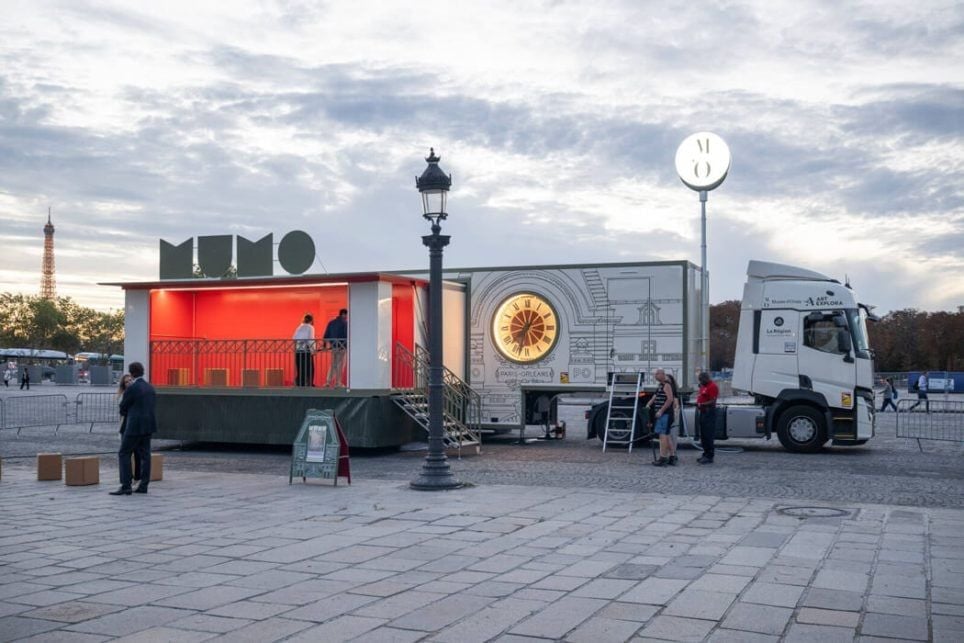
From 5 October to 18 December 2026, the MuMo Collections museum truck is visiting ten municipalities in Seine-Saint-Denis, north-east of Paris. On board, Seine-Saint-Denis, Territoire-Monde, an exhibition conceived by the departmental authority, brings together archaeological objects, cultural heritage material, archival documents and contemporary artworks from public and private collections. tourisme93.com
The exhibition connects local history with the exchanges and migrations that have shaped the area. A reproduction of a 13th-century Syrian vase, for example, illustrates the medieval trade in imported goods. Archaeologists found the original in fragments at Bondy; the version on display, made by a ceramicist, helps visitors understand its shape. fr.linkedin.com
The exhibition thus travels through the very places whose history it explores. Stops include public visiting sessions and walks that end with a tour of the truck, connecting the exhibits with the surrounding area. tourisme93.com
MuMo Collections has travelled across France since 2017 in a mobile exhibition space designed by matali crasset. It carries works from public collections, accompanied by educators who lead tours and workshops. Choosing where to stop goes hand in hand with helping visitors discover the works. mumo.artexplora.org
Another truck in the network, MuM’Orsay, houses around twenty original works from the Musée d’Orsay. Its inaugural exhibition, Le Grand Bal, explores festivities and dancing in the 19th century. Curated by Édouard Papet with the collaboration of Estelle Bégué, it includes works by artists such as Camille Corot, Henri Gervex and Jean-Baptiste Carpeaux. www.musee-orsay.fr
The first leg of the tour takes place in Auvergne-Rhône-Alpes, with stops in Nouvelle-Aquitaine and Brittany scheduled for 2027. At each stop, free admission, guided visits and workshops offer different ways to engage with the collection. A tactile reproduction of a sculpture by Degas also allows visitors to explore its form through touch. mumo.artexplora.org
In Val-d’Oise, the Fracothèque, run by the Île-de-France Regional Contemporary Art Fund, offers a further possibility. Launched on 7 November 2026, the project brings artists’ posters from its collection and prints from Natures diverses, a national commission by the Centre national des arts plastiques, to participating libraries and media libraries. fraciledefrance.com
Here, the encounter can continue at home: users of participating libraries can borrow one or two works free of charge and renew the loan every two months. The Frac has trained library staff to welcome and advise visitors. Each work comes with guidance on hanging and caring for it, alongside notes offering starting points for interpretation. fraciledefrance.com