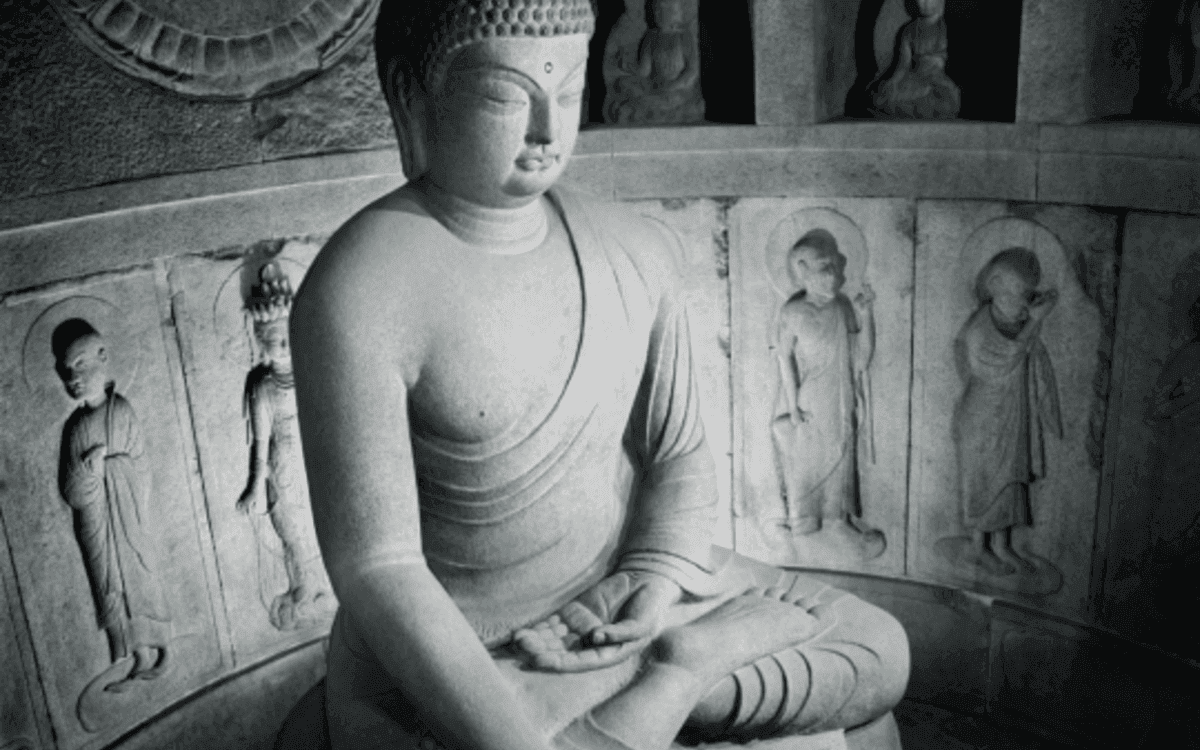
The Buddha inside Seokguram has watched the sun rise over the East Sea from the same granite seat for roughly thirteen centuries, and it has never once left the mountain where it was built.
That immobility is precisely the point. Seokguram is not a temple you visit so much as a machine for producing awe: an artificial cave near Gyeongju, in South Korea, built entirely from finely cut granite blocks fitted together with a precision that still puzzles engineers, since no mortar holds the dome together. It was raised during the unified Silla kingdom, sometime between 668 and 935, at the height of a dynasty that ruled the Korean peninsula for close to a thousand years from its capital at Gyeongju. UNESCO inscribed it as a World Heritage Site in 1995, citing exactly the quality that makes it so hard to bring anywhere else: it is a single, unrepeatable architectural gesture carved into a mountainside.
So Paris is not trying to move the cave. It is trying to get as close to the impossible as photography and touch allow. From 15 October, the Centre Culturel Coréen, working with the city of Gyeongju and Korea's National Research Institute of Cultural Heritage, opens an exhibition built around images taken by Han Seokhong, a photographer who has spent his career documenting Korean heritage sites that most of the world will never see in person. His photographs let visitors examine the cave's sculpted monks, bodhisattvas and Buddhas at a level of detail no single visit to the site itself would allow, since access to the interior is restricted and viewed through glass to protect it.
What makes the show unusual is its insistence that heritage should be felt, not only looked at. Alongside the photographs, the exhibition includes braille panels and tactile reproductions, so that visitors who cannot see the carvings can still trace their forms with their hands. An LED screen carries visitors through Gyeongju's wider constellation of sacred sites, including Bulguksa temple, which sits below Seokguram on the same mountain and was built by the same Silla hands.
The exhibition also insists that this world is not sealed in the past. A lotus pond motif recurs throughout as a symbol linking the earthly world to the Buddhist one, echoed in glazed guardian tiles from the Sacheonwangsa temple site and in a copy of the Pure Light Dharani sutra, a sacred text treated here as a physical realisation of Buddhist cosmology rather than a historical document. Four contemporary Korean artists answer that inheritance directly: Kim Eun-ha weaves recovered temple roof tile fragments and recycled fibre into new sculptural works; Lee Seung-chul remakes traditional Buddhist statuary in hanji paper; Sohn Dae Hyun carves Buddha figures in lacquer, ivory, mother of pearl and gilding; and Studio Shinyoo reinterprets the Buddhist pagoda, traditionally built to house relics and hold the wishes of the faithful, inviting visitors to pause and make a wish of their own.
From 23 November, the exhibition adds its most ambitious answer yet to the problem of an immovable monument: a hyperrealistic reconstruction of Seokguram projected across four screens, letting visitors walk, virtually, into a cave that thirteen centuries of pilgrims reached only by climbing a mountain.
The exhibition marks 140 years of diplomatic relations between France and South Korea, but its real subject is older and simpler: what a civilisation does when it wants something to last forever, and what the rest of us do when we want to see it without a plane ticket to Gyeongju.


