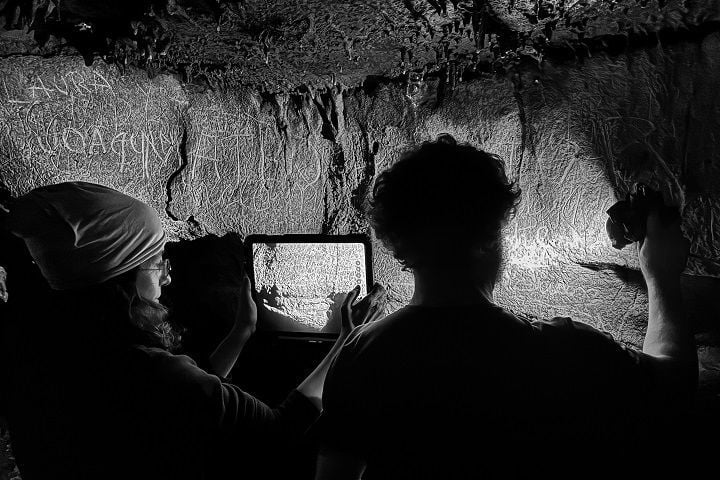
More than 650 feet inside a cave in Valencia, on walls no daylight has touched in two thousand years, someone carved the word MALACI. Nobody living had heard it before. It names a goddess nobody knew existed.
The cave is Cova de les Dones, the 'Cave of the Women', a name recorded as far back as the 18th century by the naturalist Antonio José Cavanilles, long before anyone understood why it fit. Researchers from the University of Alicante and the University of Zaragoza now think they know: deep in one chamber, they have documented at least 110 Latin inscriptions, the largest known concentration ever found in a Roman cave sanctuary, and the evidence points to a sanctuary where women were not just present, but running the show.
Five of the inscriptions are votive offerings addressed to a goddess called, reverently, Domina: 'the Lady'. Three of those name her MALACI, a title historian Silvia Alfayé Villa of the University of Zaragoza says had never been recorded before. What it means, and whether it connects to the water that runs through the cave, is still being worked out.
What is not in doubt is who left the offerings. Archaeologist Virginia Barciela of the University of Alicante has identified several women's names among the inscriptions. Scattered nearby: jewellery, chalice-shaped vessels, ceramic fragments, animal bones, and spindle whorls, tools for spinning thread, which Barciela reads as textile-working offerings that match the female authorship of the texts. Archaeologist Sergio García-Dils, of Spain's National University of Distance Education, notes that the inscriptions all name one deity and cluster tightly in a single chamber far from the entrance, which he takes as a sign of an organised, dedicated cult rather than scattered private worship.
The chamber had already surprised everyone once. Last year the same team found a first-century coin from the reign of Emperor Claudius there. Five years before that, another team found Paleolithic paintings elsewhere in the cave, some over 24,000 years old, one image overlaid by the claw mark of a cave bear extinct since roughly that date. A single cave, holding an Ice Age menagerie and a forgotten goddess, both waiting in the dark for someone to bring a lamp.


