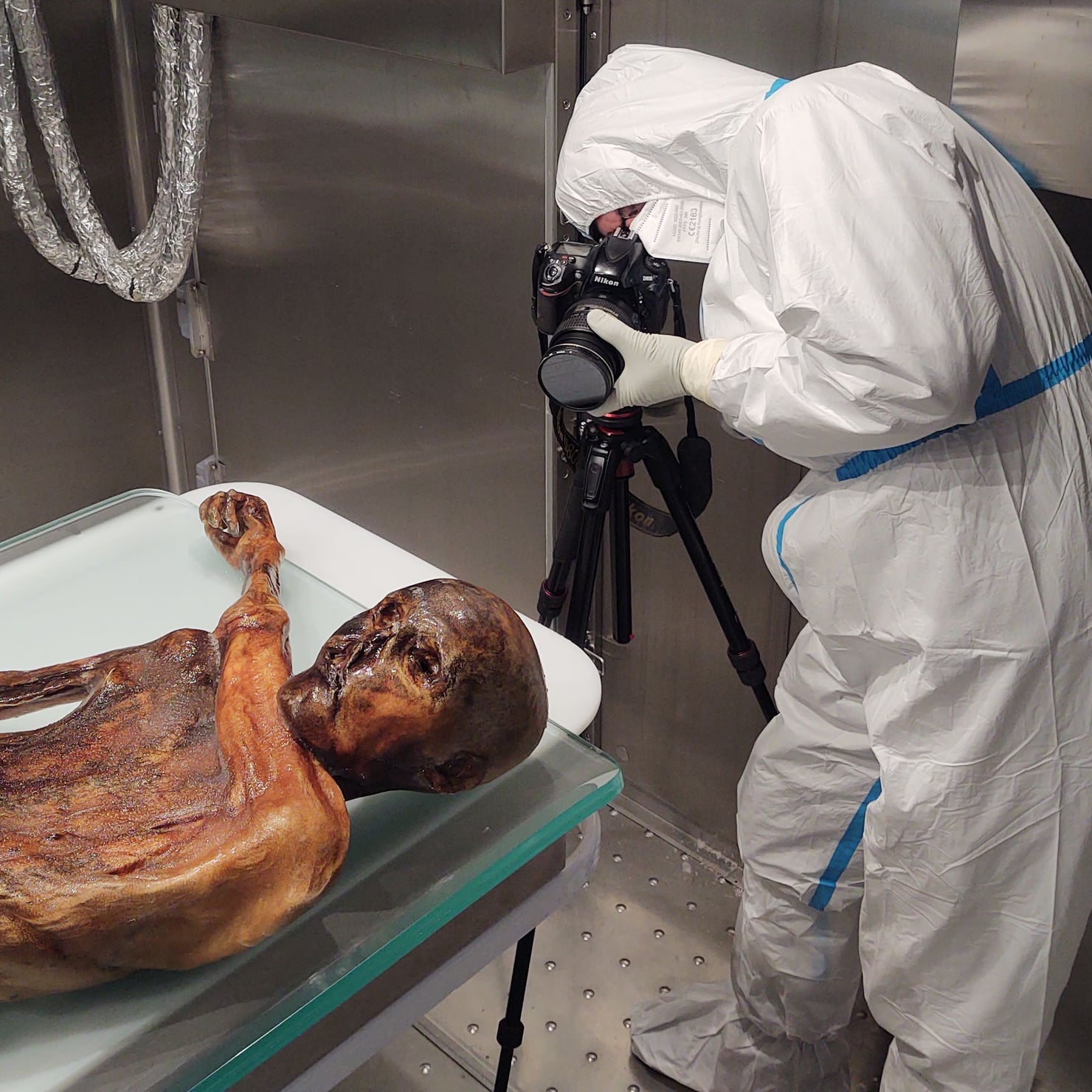
Ötzi is preserved at the South Tyrol Museum of Archaeology in a refrigerated cell designed to maintain conditions similar to those that allowed him to survive for more than 5,000 years. A thin layer of ice protects much of his skin, but makes it more difficult to photograph the surface: it reflects light and can conceal certain details.
Every new investigation must therefore address a specific responsibility. Studying the remains means gathering information, but approaching them, illuminating them or repeatedly subjecting them to examination also means intervening in the delicate balance that ensures their preservation.
To reduce the need for this, the Museum commissioned Arc-Team to create an extremely high-resolution three-dimensional record of the mummy and the objects found with it. The result is described as a ‘digital twin’: not simply a visual reproduction, but a system that connects data obtained through different techniques. The project was presented in 2025 at the 11th World Congress on Mummy Studies in Cusco and described in greater detail in a scientific study published in 2026.
The external model of the body was built from 1,294 high-resolution photographs. Through photogrammetry, images taken from different positions were compared to reconstruct the mummy's three-dimensional form. This record was linked to data from a computed tomography scan of the entire body, carried out in 2021.
The two techniques reveal complementary aspects. Photogrammetry records the visible surface: the body's form, the skin and its variations. Computed tomography, by contrast, makes it possible to observe internal structures without opening or dissecting the mummy. Integrating the two allows researchers to move from the surface to the anatomy while maintaining the correspondence between the different layers of information.
The difficulty did not lie simply in collecting a large number of images. Ötzi could not be moved and photographed like an ordinary object. Ice and humidity produced reflections, while some parts of the body were difficult to reach. The research team therefore combined photogrammetry with other techniques, including polarised photography and artificial intelligence systems used to process complex, reflective surfaces.
The project also includes the objects found with the mummy: artefacts made of leather, fur, wood, flint and copper, including the bearskin cap, parts of the clothing, the belt, the axe and the arrowheads. Materials this varied respond to light in different ways and required specific solutions to be documented.
The model thus connects the body with its material context. The objects do not appear as accessories added to a reconstruction, but as necessary sources for understanding the person, his technical knowledge and the environment in which he lived.
One of the most important applications concerns monitoring. Documentation this precise makes it possible to record the condition of the mummy and the artefacts at a particular moment. By comparing subsequent acquisitions, it will be possible to identify any changes to the surfaces and assess the effectiveness of conservation measures.
The model may also allow researchers to examine certain data without requiring new access to the original remains each time. It does not remove the need to study the mummy directly when the scientific question requires it, but it makes it possible to distinguish essential examinations from those that can be carried out using the documentation already available.
The project was created entirely with free and open-source software. This choice is not only about the cost of the tools: it aims to make the procedures verifiable and reproducible, and to reduce the risk that the data will become unusable when proprietary software is changed or no longer available.
The Museum also identifies future web access to the model as an objective. It is necessary, however, to distinguish the research model from the experience intended for the public: based on the information available, the complete web application does not yet appear to have been published. Presenting it as already accessible would therefore be premature.
Describing this documentation as a ‘digital twin’ does not mean claiming that it could replace Ötzi. The preserved body remains the source from which the data originate and to which every interpretation must return. The model serves a different purpose: it brings together observations that cannot all be made on the remains at the same time, and allows them to be shared without unnecessarily repeating the acquisitions.
In this case, technology does not create distance from the material remains. It helps establish when it is genuinely necessary to return to them directly, and when it is more responsible to work with the information already collected.


