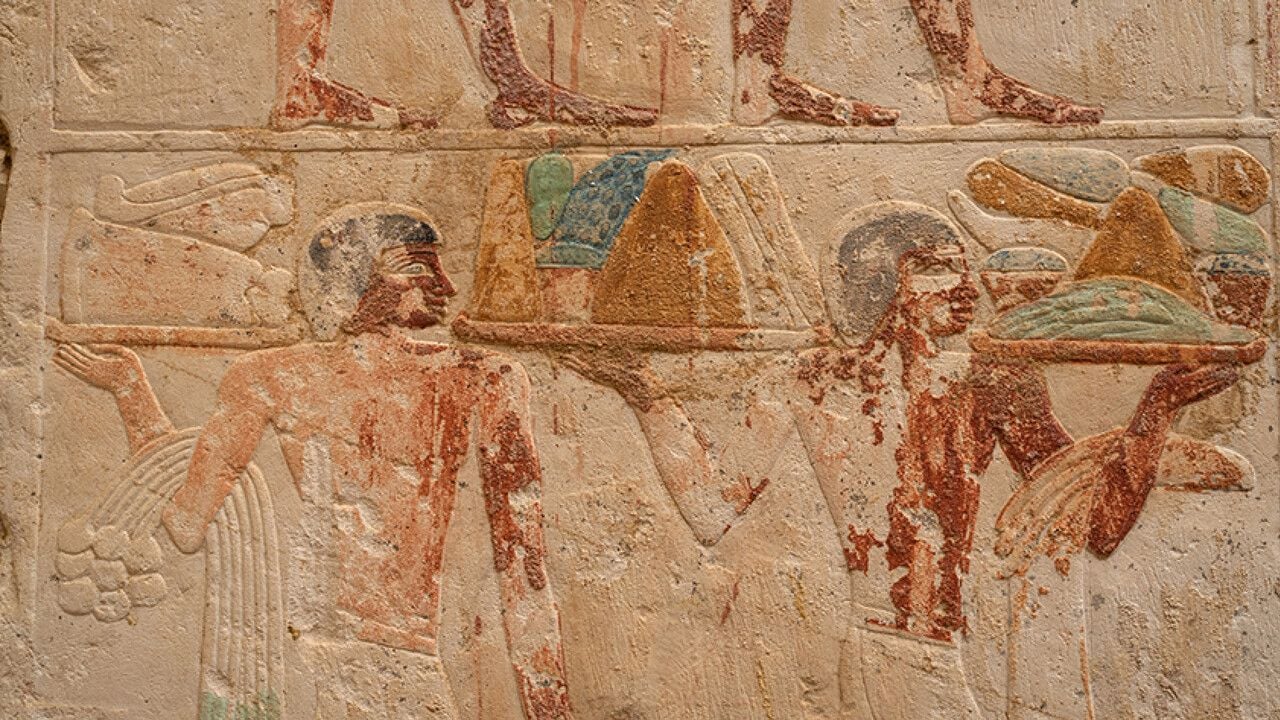
The colours have not given up. Four and a half thousand years underground, and the paint inside two burial chapels at Saqqara is still vivid enough to read like it was finished last week.
A joint Spanish-Egyptian archaeological mission has uncovered a tomb dating to the late Fifth Dynasty, roughly 2,500 BCE, during the reign of King Djedkare Isesi, one of the last rulers of that dynasty. It sits in an area of Saqqara known as the Mariette Necropolis, named after the French archaeologist Auguste Mariette, who began digging there in the nineteenth century and went on to found the Egyptian Museum in Cairo. The ground had been known to scholars for more than 150 years. Nobody had properly excavated it.
Inside, two chapels hold the names of two men, father and son, whose jobs tell you almost everything about how Old Kingdom Egypt actually ran. The son, Yunmen, was a judge, a court administrator and chief scribe, the official who reviewed petitions and complaints, essentially the person citizens went to when they wanted the state to listen. His father, Iti, worked as a scribe managing farmland and offerings, the paperwork that kept temples and estates fed.
Hisham El Leithy, secretary general of Egypt's Supreme Council of Antiquities, said the find sheds new light on tomb architecture, decorative style and the administrative posts held by senior officials of the period. He also pointed out what makes this particular patch of desert unusual: Mariette walked over it in the 1800s, and for a century and a half afterwards, nobody returned with the rigour to document it properly.
The mission is a joint project between the Autonomous University of Barcelona and Egypt's Supreme Council of Antiquities, working the 2026 excavation season at one of the largest and most significant necropolises of ancient Egypt, thirty kilometres from central Cairo.
What lingers is not the discovery itself but the gap it closes. A judge and a scribe, a father who managed harvests and a son who managed grievances, sat under Mariette's boots for a century and a half before anyone finally knelt down to look properly.


