In 1823, a Paris newspaper described a hillside neighbourhood where the air was clean, where blackbirds and nightingales sang along with verses being composed on the spot, and where the din of the city at night sounded no louder than a distant waterfall. The place was Montmartre, or rather its lower slopes, and Parisians had already given it a nickname: Nouvelle Athènes, the New Athens.
That name survives, almost accidentally, in a small museum tucked behind the Rue Chaptal, in the ninth arrondissement. The Musée de la Vie romantique has just reopened after a year and a half of restoration, and it remains one of the more improbable survivals in a city that rarely lets its real estate stand still for two centuries.
The site began as farmland. Around 1820, Paris was bursting at its seams, and the fields and orchards of the Montmartre foothills were parcelled up for housing. Streets of apartment buildings rose in the neoclassical taste of the day, and artists moved in fast: Eugène Delacroix, Auguste Renoir, Gustave Moreau, who later got a museum of his own a few streets away. Vincent van Gogh came often too, visiting his brother Theo, an art dealer who lived and worked nearby. But it is the Dutch painter Ary Scheffer whose house survives most intact: a villa and studio built around 1830, reached by a narrow path off the Rue Chaptal, gathered around a courtyard and garden that still feel improbably rural for the ninth arrondissement.
Scheffer's circle is the museum's real subject. Frédéric Chopin and George Sand both moved through these rooms; so did the philosopher and historian of religion Ernest Renan. A bronze bust by Christian Daniel Rauch honours Johann Wolfgang von Goethe, whom the New Athens set treated as a kind of patron saint from afar, and the museum holds something more startling: a wash pen drawing, an Italian impression, that Goethe gave to Scheffer himself. Scheffer, who had done more than almost anyone to make Goethe's work known in France, kept it as a personal gift from the writer he had helped to canonise.
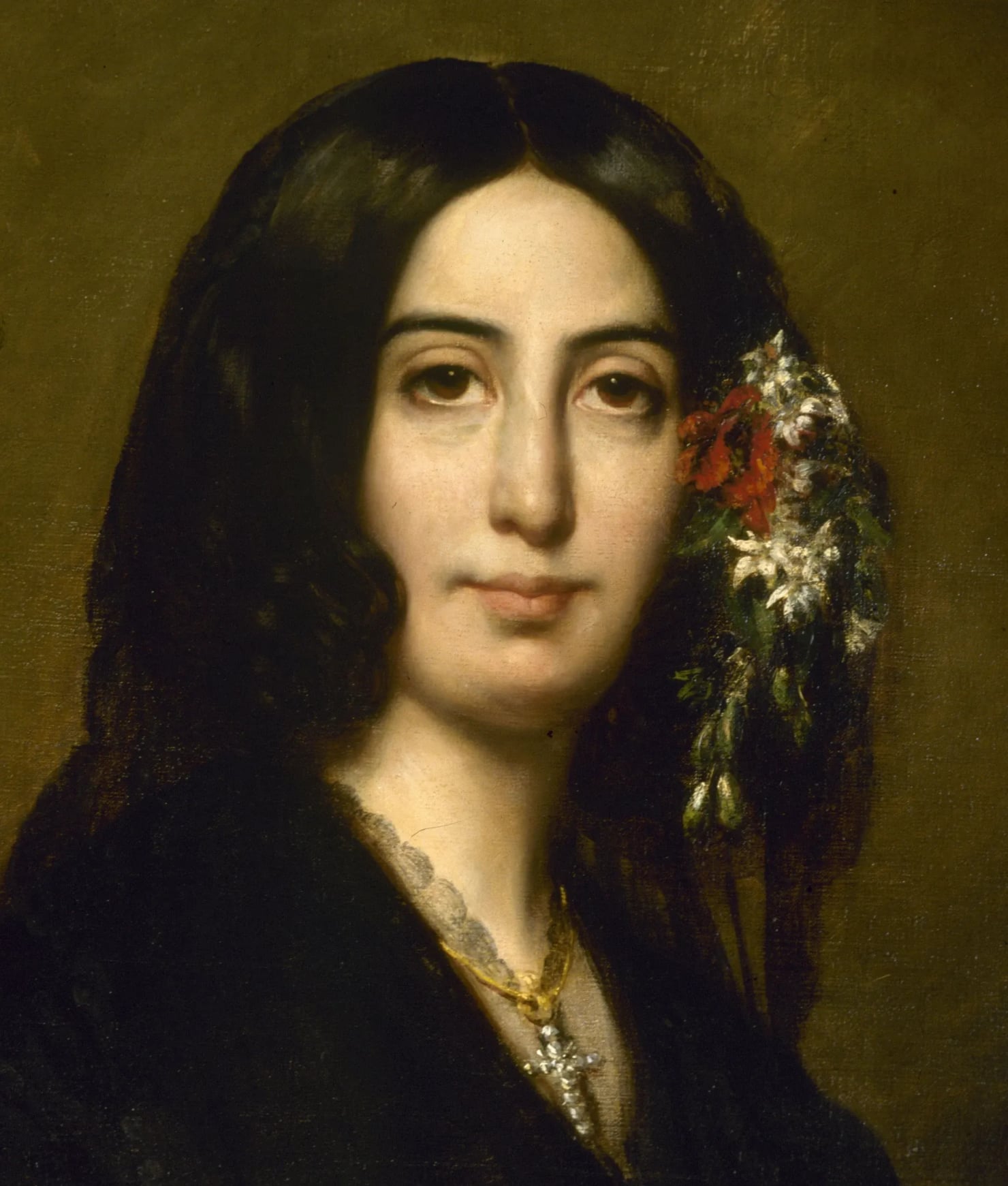
The collection leans towards portraits and literary scenes, furniture, small sculpture, jewellery and memorabilia, much of it displayed in rooms so small they feel domestic rather than institutional. Its centrepiece is a salon laid with a thick, boldly patterned carpet, where a plaster cast of Chopin's hand sits near Auguste Charpentier's famous 1837 portrait of George Sand, flowers white and red in her hair.
For the reopening, the museum has turned to landscape painting from the early nineteenth century, a moment when French artists began drifting from idealised Mediterranean scenery towards their own unfiltered countryside, partly under the influence of English painters such as John Constable, who found unglamorous beauty on his own doorstep at Hampstead Heath. Curator Dominique Lobstein's exhibition, 'Face au ciel: Paul Huet et son temps', tracks this shift through fifty loaned works, with particular attention to Huet (1803 to 1869), a self-taught painter with an unusually sharp eye for weather and cloud, whether at the ruined castle of Pierrefonds or on the Normandy coast.
As the Frankfurter Allgemeine Zeitung notes in its report from Paris, the restoration has not been entirely gentle: technical upgrades have smoothed away some of the patina outdoors, and Scheffer's studio, with its tall library cabinets, easels, stove and north-facing light, has been altered with reversible fittings for the current show, making it hard to recognise. Moss and ivy, the paper predicts, will soon reclaim their rights outside regardless.
One detail lingers longer than any restoration debate. George Sand and her son Maurice liked to conjure small watercolours of imaginary landscapes using a printing technique called dendritic painting, pressing pigment between surfaces to create crystalline branching forms that read as trees, coastlines, imagined terrain. They look, unmistakably, like something Max Ernst would paint a century later. Nobody in that garden on the Rue Chaptal could have known that.


