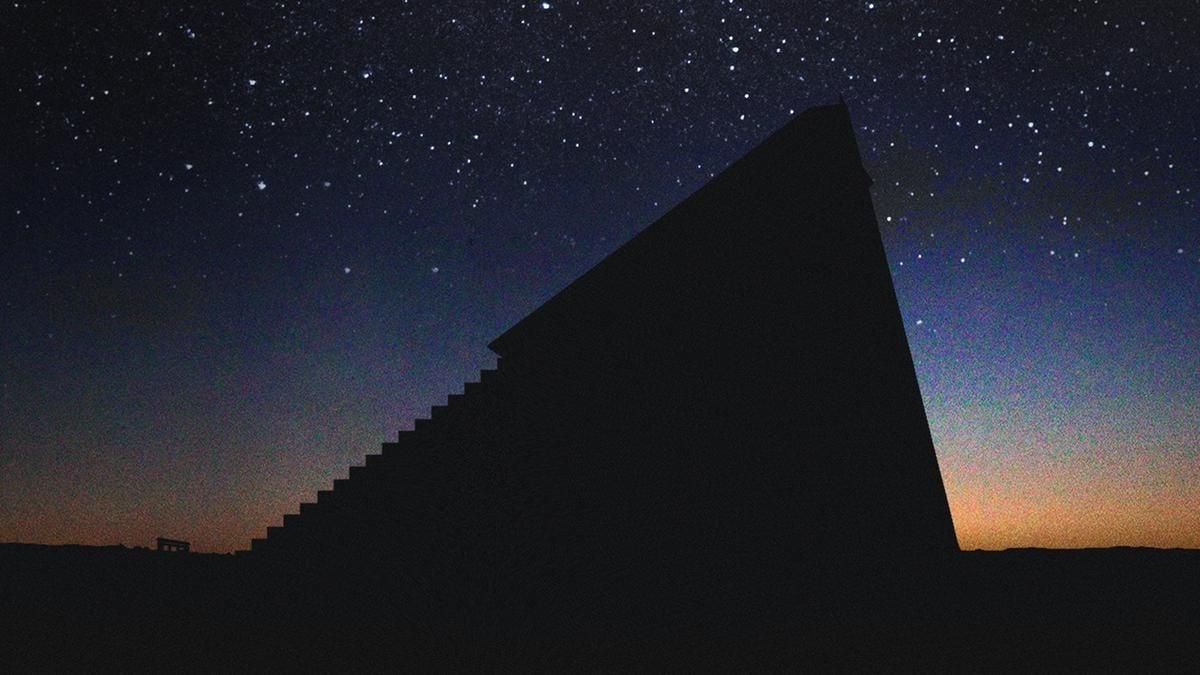
In 1971, a thirty-something artist named Charles Ross began sketching a structure in the New Mexico desert that would not be finished in his lifetime, or so it seemed for a long time. He is now in his late eighties. The structure, called Star Axis, is still not quite done.
What he is building is sometimes described as a granite pyramid, though that undersells it. Star Axis is an observatory, but not one that tracks anything so modest as a season or a year. It is built to make visible a cycle of 26,000 years: the slow wobble of the Earth's axis, known to astronomers as precession, which means that Polaris, the star that has anchored human navigation for millennia, is not actually fixed at all. It only looks that way over a human lifespan. Ross wanted to build something that would let a person feel that shift, not just be told about it.
That is the strange, quiet ambition at the centre of this project: to compress a timescale that dwarfs civilisation itself into something a visitor can stand inside and perceive with their own eyes. A staircase aligned with the Earth's axis. A chamber engineered so that starlight falls in specific, calculated ways. Fifty years of granite, concrete and desert labour, all in service of making 26,000 years feel, for a moment, human-sized.
Ross's decades of work are captured in a new short documentary, Where the Earth Meets the Sky, by filmmaker Rafael Salazar Moreno, distributed by Aeon Video. The film catches Star Axis on the edge of completion, which is itself a strange place to sit after half a century. Ross started this as a young man. He may finish it, if he finishes it, as one of the oldest living land artists in the United States.
The documentary carries its own buried timescale. It includes archival footage shot by the filmmaker Wendy Apple, who had been documenting Ross's project for years before she died in 2017. She never saw Star Axis completed, and she never finished her own film about it either. Moreno's twenty-four minute treatment absorbs her footage and, in doing so, becomes a film about two unfinished things: a monument to deep time, and the record of a person who ran out of time trying to capture it.
There is no obvious ending to a story like this, because Star Axis does not have one yet. What there is, instead, is a man in the desert, still working, still aligning stone to a star that will not stay where it is. Somewhere in that lies the actual subject: not the granite, not even the astronomy, but the particular, stubborn human refusal to accept that some things are too big to build.


