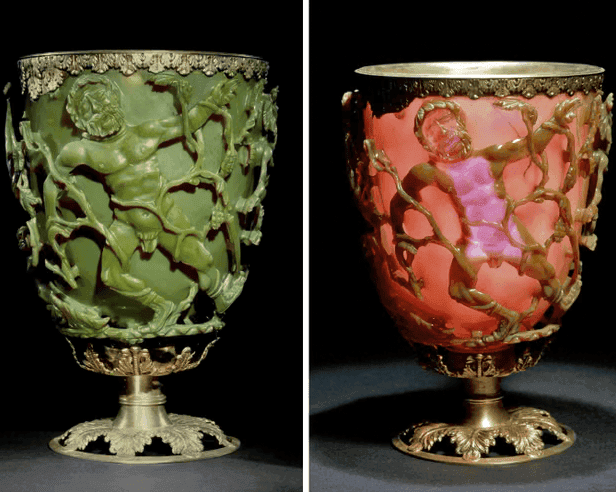
Jade green when lit from outside, ruby red when light passes through it: the Lycurgus Cup owes part of its fame to the way its glass behaves. Held at the British Museum, the fourth-century Roman vessel contains tiny particles of gold and silver that interact with light to produce these different appearances.
In Sheffield, glass technologist Lisa Hollands worked with Roman glass specialist Caroline Jackson to make a material with similar optical properties. Drawing on earlier studies of the cup and ancient production techniques, they prepared a base glass using modern ingredients.
The challenge was to introduce small amounts of gold and silver in a form that would produce the desired effect. Hollands tested combinations of raw materials, types of furnace and oxygen levels. After four months of trials, the glass showed colours similar to those of the cup, with one day to go before the exhibition for which it had been made opened.
A sample was displayed at LightFest in 2025, and the experiments continued with further firings and analysis. Reproducing the colours offers a way to investigate the conditions needed to create them, although the exact steps Roman glassmakers followed remain unknown.
The next stage took the material from the laboratory to artist Elliot Walker’s studio. Commissioned by the university to make a sculpture, Walker brought together the story of Lycurgus depicted on the cup and the figure of the Farnese Atlas. In place of the globe held by Atlas is a vessel. A blown-glass element lets light pass through the material, revealing its dichroic effect.
The sculpture will be displayed at Sheffield’s Millennium Gallery during the Festival of the Mind, from 6 to 15 November 2026. It will then move to the university’s Turner Museum of Glass, where dedicated lighting will make both colours visible.