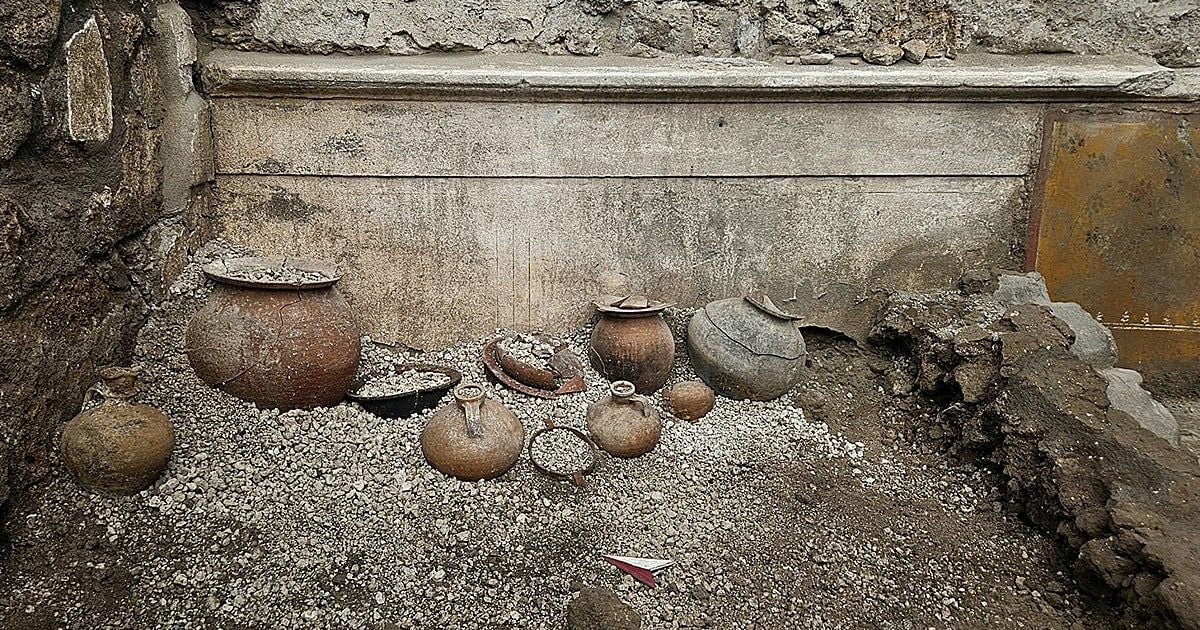
The cupboard survives as impressions in volcanic deposits, alongside the objects it held when the eruption of 79 CE buried the house. At Pompeii, archaeologists have reconstructed the shape and contents of a large cupboard in the corner of a room. The house’s façade was excavated in 1912; the new work explored rooms behind it as part of a project to restore and improve access to the nearby Insula of the Chaste Lovers.
The cupboard held objects with different uses. Alongside bronze, glass and ceramic vessels were tweezers, a slate slab for mixing pigments, a small perfume flask and an incense burner. These items associated with personal care suggest to the archaeologists a possible connection with women’s lives.
A small basket made from woven plant fibres held 38 bronze coins. A wooden box, of which only a few traces survive, contained lead weights, possible evidence that people in the household engaged in trade. The cupboard brought together household utensils, personal belongings and money.
Among these possessions, a cloth bag held at least 24 small pierced objects, probably strung together as a necklace. Made from faience, bone, glass paste and rock crystal, they depict Bes and Mercury, as well as hands, feet, pine cones and bunches of grapes. The archaeologists identify them as crepundia, ornaments and amulets associated with childhood that could protect children and form part of their play. Comparisons with other archaeological and literary evidence suggest that keeping such objects into adulthood could have preserved a connection to personal and family history.
The bag also left clues to what happened as the room was destroyed. In the archaeologists’ reconstruction, a shelf collapsed, causing the bag to slip and break open, scattering the pendants across several levels. The positions of the small finds and the remains of the cloth helped them piece together this sequence. Fragments of sediment preserving traces of the fabric were taken to the Pompeii Archaeological Park’s laboratory for study.