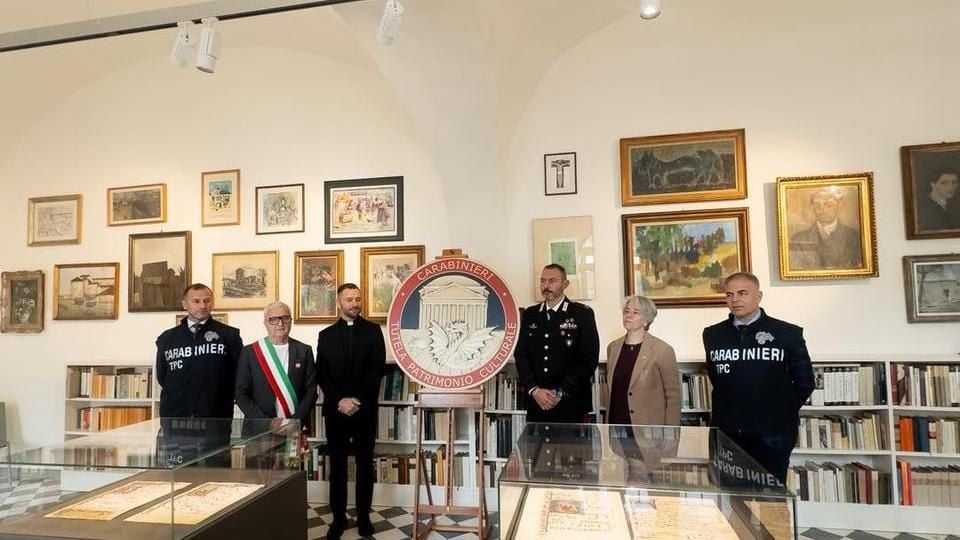
On the night of 8 March 1982, someone walked out of the Museo di Arte Sacra in Colle di Val d'Elsa with thirty sheets of parchment small enough to carry under an arm and, as it would turn out, valuable enough to vanish for more than four decades. They were not paintings in gilt frames. They were choirbook pages, cut from six antiphonaries that had belonged for centuries to the convent of San Lucchese in Poggibonsi, their surfaces filled with the kind of hand-painted initials and miniature scenes that monks once used to mark the start of a chant. Nobody was ever caught.
What happened between 1982 and now is the part that tends to get skipped over in the official language of restitution ceremonies, and it is the part worth sitting with. Stolen illuminated manuscripts do not disappear into thin air; they disappear into the grey, half-lit market of private collectors and dealers who ask few questions, sometimes for years, sometimes for a lifetime. These particular pages resurfaced more than once. A first batch was recovered by Italy's Carabinieri Tutela Patrimonio Culturale (the TPC, the art squad that exists precisely because ordinary police work rarely covers manuscripts) and put on public display in 2020 at Palazzo Pitti in Florence, then again in 2022 at the city's Complesso San Pietro. Now a further thirty pages have followed them home, in a case that only moved because one person happened to be paying close attention.
That person was a private citizen, an art scholar, who spotted the pages, recognised their style and their damage, and connected them to a forty-year-old theft file most people had long forgotten. It is a reminder that the recovery of stolen heritage rarely hinges on high technology or international task forces; it hinges on someone who has looked at enough illuminated manuscripts to know one when they see it again, out of context, decades later.
The pages themselves come from two distinct liturgical cycles, one made between the late thirteenth and early fourteenth century, the other around the mid-fifteenth, which means the theft did not just strip a museum of objects, it tore two separate medieval choirs apart page by page. Since being seized, they have been in the custody of the Opificio delle Pietre Dure in Florence, the state's specialist conservation institute, with expert input from Sonia Chiodo, an art historian at the University of Florence who also curated the 2020 Palazzo Pitti exhibition.
The formal handover took place at the Complesso San Pietro, returning the pages to the Archdiocese of Siena, Colle di Val d'Elsa and Montalcino, their legal owner, and finally to the mayor of Colle, as reported by La Nazione. Piero Pii, the city's mayor, called it the return of 'a piece of history to collective memory'. It is a fair description, but it leaves out the quieter fact underneath: for forty-three years, these six choirbooks have existed as a scattered, incomplete story, and even now, with thirty more pages home, nobody has said how many are still missing, or where.


