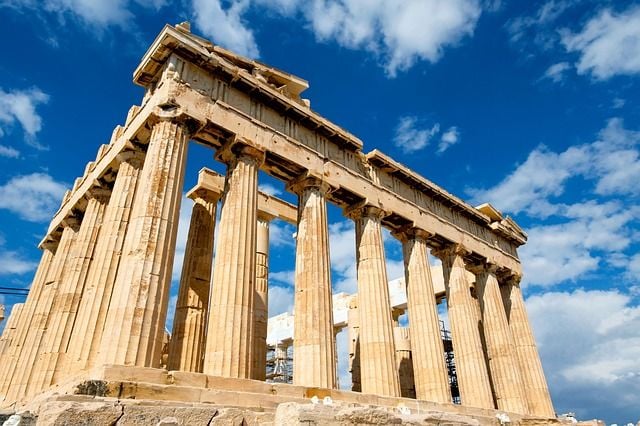
At first glance, the Parthenon appears to be made up of straight lines, level surfaces and columns. Look more closely, and the geometry shifts. The platform beneath the columns, known as the stylobate, rises slightly towards the centre. The columns swell gently in the middle, a feature called entasis, while those at the corners are slightly larger than the others.
For a long time, these variations have been understood as optical corrections: deliberate adjustments intended to compensate for distortions in human perception and make the temple look more regular.
Alain Goriely, a mathematician at the University of Oxford, questions this explanation in a study published in *Royal Society Open Science*. He does not dispute that the architectural features exist. Rather, he argues that the historical and scientific evidence is insufficient to establish that they were designed as optical corrections.
Entasis offers a clear example. The slight swelling of the columns is often explained as a way to stop a perfectly straight shaft from appearing narrower in the middle. But Goriely notes that there is not enough empirical evidence to show that this illusion occurs. The curvature is also so slight that it would be difficult to perceive from many viewing distances.
The corner columns, which are slightly wider than the others, raise a similar question. Goriely considers the evidence linking this difference to a specific visual effect insufficient.
The optical explanation has ancient roots. An important part of it is traced to Vitruvius, who wrote several centuries after the Parthenon was built. In the nineteenth century, more precise measurements documented the building’s curves in detail. But confirming that an architectural variation exists does not, by itself, establish why it was introduced.
The study does not offer a definitive new purpose for the curves, the entasis or the other variations. Instead, it calls for a distinction between what can be measured and the explanations developed over time to interpret it.
The Parthenon still shows the choices made by its builders. What is harder to establish, centuries later, is what intentions lay behind them.


