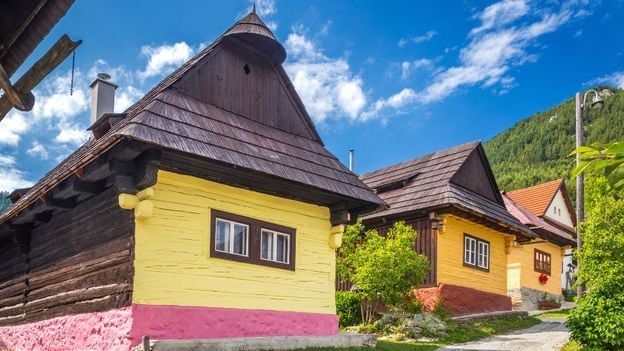
Vlkolínec has roughly twenty full-time residents and forty-five cottages. Every year, more than a hundred thousand people arrive to see them.
The village sits in the mountains of central Slovakia, a cluster of brightly painted, fairytale-like houses gathered around an eighteenth-century bell tower. It is the kind of place that looks unreal in photographs, which is precisely the problem. In 1993, Unesco added Vlkolínec to its World Heritage List for its exceptionally intact traditional architecture. Since then, tourists have outnumbered residents by roughly five thousand to one, every single year. Now some locals want out. They are asking Unesco to take the village off the list.
Seven thousand kilometres away, in the Ngorongoro Conservation Area of Tanzania, home to some of Africa's most iconic safari landscapes and to Maasai pastoralist communities, the Maasai International Solidarity Alliance is making the same request. Their argument is not about crowds but about land: they say conservation rules tied to the site's international protected status have pushed residents off grazing grounds their families have used for generations.
Two very different places, one identical demand: remove us from the list that was supposed to protect us.
Unesco's World Heritage List began after the Second World War as an effort to shield culturally and environmentally significant places from conflict, industrialisation and reckless development. It inscribed its first twelve sites in 1978. Today it protects 1,248 sites in 170 countries, from Machu Picchu and the Great Wall of China to Romania's wooden churches of Maramureș. The badge can unlock international conservation funding and has genuinely saved places: the Belize Barrier Reef Reserve System came off Unesco's 'In Danger' list in 2018 after stronger protections were introduced, and decades of coordinated restoration helped rescue Angkor Wat from war damage and looting.
But a listing does something else almost automatically, according to Greg Richards, a researcher who studies cultural tourism and overtourism: it drives visitor numbers up. "There is a whole range of possible things that can result from getting a Unesco listing," he told the BBC, "but one that will definitely happen is increased visitation." He compares the designation to a star rating in a guidebook, a signal that tells travellers: this is a must-see.
The trouble is that many of today's listed sites are not empty ruins. People live in them, work in them, raise children in them. Venice became a World Heritage site in 1987 and is now one of Europe's most overtouristed cities, its resident population steadily shrinking as tourism expands. In Lijiang, China, listing in 1997 helped transform parts of the historic centre, known for its Naxi Indigenous culture, into a corridor of guesthouses and souvenir shops that some researchers say has diluted the life that made the place worth protecting in the first place. In Marrakesh, the Unesco-listed medina has seen rising property prices and gentrification driven by tourism and foreign investment.
Researchers have a word for the pattern: museumification, the slow drift of a living community into a place organised around visitors rather than residents. Social media has accelerated it further. Before Instagram and TikTok, John H Stubbs, a preservation scholar and former vice president at the World Monuments Fund, notes that travellers relied on guidebooks. Richards puts it more bluntly: "Now, increasingly, you're following other tourists."
Unesco is not blind to this. Peter DeBrine, the organisation's sustainable tourism specialist, says Unesco now asks sites to draw up visitor-management plans to prepare for growth and ease pressure on fragile areas. "We're not trying to discourage tourism at all," he says, "but just help that tourism to support conservation and the heritage." Sites are allowed to modernise, provided they preserve what Unesco calls their 'outstanding universal value', the very qualities that earned them the listing. In practice, that clause becomes a fault line: what one community sees as necessary new housing, an evaluator elsewhere may see as a threat to authenticity, a word Richards calls "very dangerous" precisely because it means different things to different people.
What neither Vlkolínec nor Ngorongoro is asking for, though, falls squarely outside Unesco's toolkit. The organisation can assess and respond to damage done to a site. It has no clear mechanism for a grievance that runs the other way: not damage to the place, but damage done to the people who were already living there when the world decided their home was too precious to leave alone.


