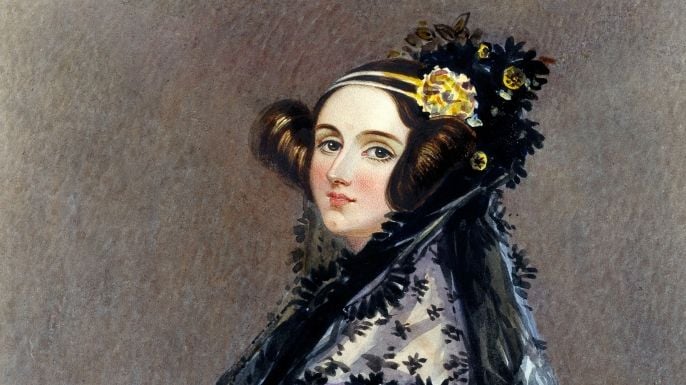
In 1843, a thirty-six-year-old countess sat down to translate a French academic paper and ended up writing something that would not exist as a working object for another hundred years: a computer program. She had no computer to run it on. The machine she was writing for, Charles Babbage's Analytical Engine, was never finished. It lived only as drawings, brass prototypes, and the restless imagination of its inventor. Ada Lovelace programmed a device that did not exist for a purpose nobody had yet named, and she got it right.
She was the daughter of Lord Byron, the poet, though she barely knew him. Her mother, Anne Isabella Milbanke, terrified that her daughter might inherit Byron's romantic instability, had her tutored intensively in mathematics and music instead. It worked, in a way nobody expected. Lovelace met Babbage, already known for his Difference Engine, a two-foot-high hand-cranked contraption with two thousand brass parts built to calculate mathematical tables. He was working on something far more ambitious: the Analytical Engine, a machine that could, in principle, be fed instructions and carry out any sequence of operations you gave it.
When the Italian mathematician Luigi Menabrea published a paper in French describing the Analytical Engine in 1842, Babbage asked Lovelace to translate it into English. She spent nine feverish months on the job, and what she delivered was not a translation. It was a translation with a set of Notes appended, three times longer than the original article, that went well beyond explaining Babbage's machine. According to the San Diego Supercomputer Center's Women in Science project, those Notes are the entire source of her lasting fame, and for good reason: in them, Lovelace described what would later be recognised as an algorithm, a step-by-step method for the Analytical Engine to compute Bernoulli numbers. It is regarded as the first computer program ever written, for a computer that would not be built for a century.
Stephen Wolfram, who spent years working through the original correspondence between Lovelace and Babbage to settle the argument over her legacy, found letters that read, in his words, a lot like project emails might today, just dressed in Victorian English. What he found was a woman who saw herself as explaining Babbage's ideas, checking her claims with him at every step, and yet was, in his account, clearly in charge of the work. Babbage himself seems to have sensed she had gone further than she gave herself credit for. When her notes appeared in print, he told her she should have written an original paper. Michael Faraday called her the rising star of Science.
What set her writing apart was not just the code itself but the leap she made past it. Where Babbage saw a machine for crunching numbers, Lovelace described something closer to what we would now call a general-purpose computer, a device suited, in her own words, to developing and tabulating any function whatever. She speculated that such a machine could one day manipulate not just numbers but symbols, even music, generating compositions of any degree of complexity. Nobody else writing about the Analytical Engine in 1843 was thinking in those terms.
Historians have argued for decades over how much credit belongs to her rather than to Babbage. Some have cast her as a gifted expositor dressing up someone else's ideas; others as the true visionary of the pair. Wolfram, after going through the archive himself, comes down on the side that it was Ada who conceived what the Analytical Engine should be capable of, an imaginative reach that outran its own inventor.
She never got to see whether she was right. Barred from the Royal Society's library because she was a woman, and struck by a severe illness in her thirties, Lovelace died of cancer at thirty-six. Her Notes slipped into obscurity for decades before historians of computing rediscovered what she had written. She had described the logic of software before there was hardware built to run it, for a machine that existed only in brass fragments and blueprints, and got there first.


