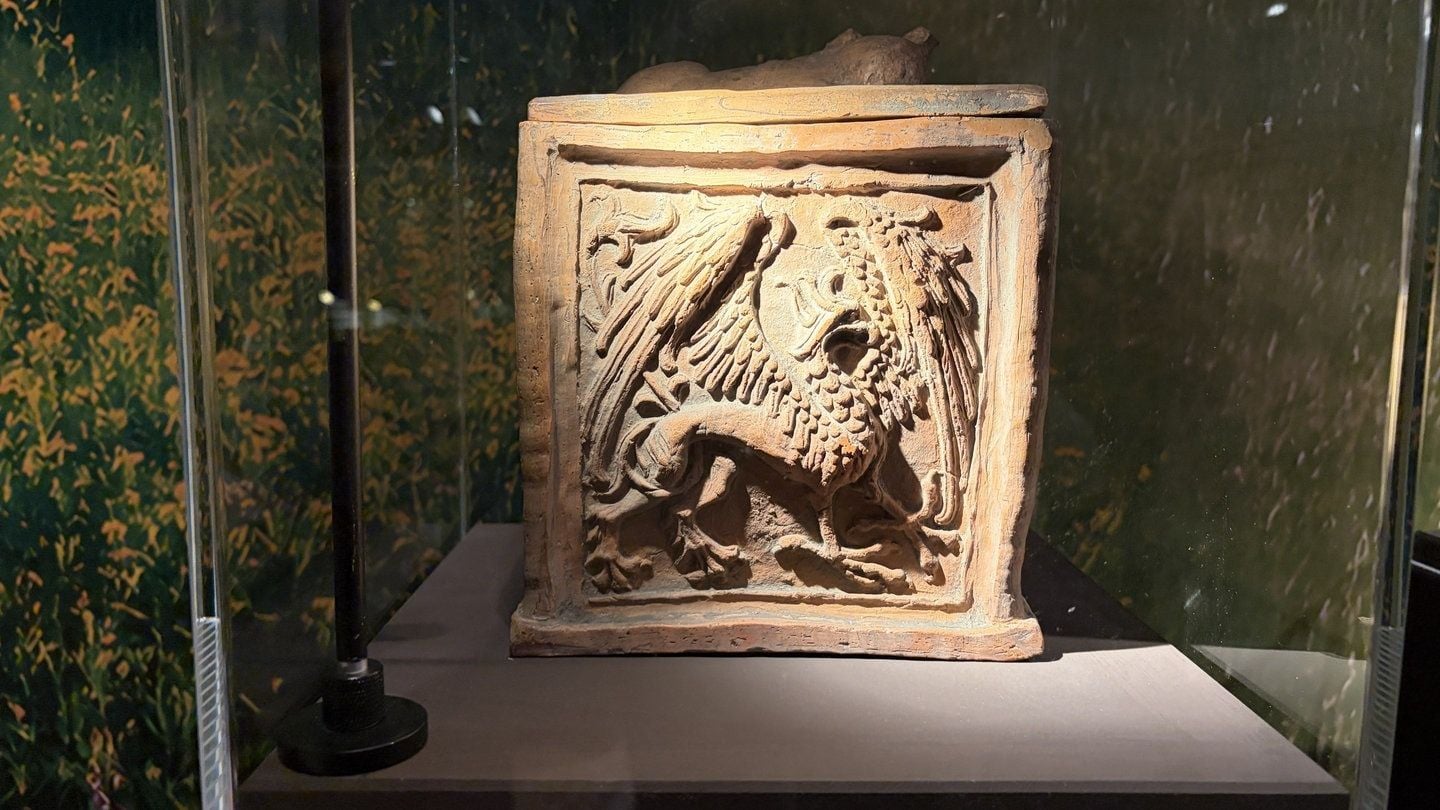
Its decoration recalls antiquity, but the urn was made in the nineteenth century. It is attributed to Konrad Kaufmann, a goldsmith and antiquarian from Speyer who is said to have sold it as an ancient artefact. On loan from the Historisches Museum der Pfalz, it is now on display at the Museum bei der Kaiserpfalz in Ingelheim, Germany.
The urn is one of around thirty objects in ‘ArchäoGELOGEN? Fakt oder Fake’, which runs from 31 October 2026 to 31 October 2027. Each display follows a sequence: a description first introduces the object and where it was supposedly found; a second panel then explains its history. Visitors can form their own judgement in between.
The urn is a forgery, but not every object has the same explanation. Some are genuine; others have been misinterpreted or manipulated. The exhibition asks visitors to examine both the objects and the information used to describe them. What evidence supports a claim about an object’s origin, purpose or age?
One display case holds a tiny skeleton, presented as that of a Heinzelmännchen, a household spirit from German folklore. Its story places its discovery during building work in Bacharach. In fact, archaeology students at Johannes Gutenberg University Mainz made it for the exhibition. The invented story is part of the display, and visitors are eventually given the explanation.
The students helped develop the exhibition under the guidance of Professor Peter Haupt, working with curators Isabel Kappesser and Ingeborg Domes. Alongside deliberate deceptions, it considers mistakes that can arise from incomplete information or unsound conclusions, including in the work of specialists.
- Stadt Ingelheim am Rhein presentazione della mostra
- Museumsverband Rheinland Pfalz progetto espositivo
- Museum bei der Kaiserpfalz scheda della mostra
- SWR Aktuell servizio di Christiane Spohn
- Metropolitan Museum of Art urna cineraria romana
- Stadt Ingelheim am Rhein / Museum bei der Kaiserpfalz
- Museum bei der Kaiserpfalz