Comparing fragments of ancient cloth is difficult when their fibres are already fragile. In Luxor, the Spanish-Egyptian C2 project is testing a method developed to study the canvases beneath paintings. The research team suggests that the textiles may be connected to the ritual rearrangement of royal mummies before their transfer to Deir el-Bahari.
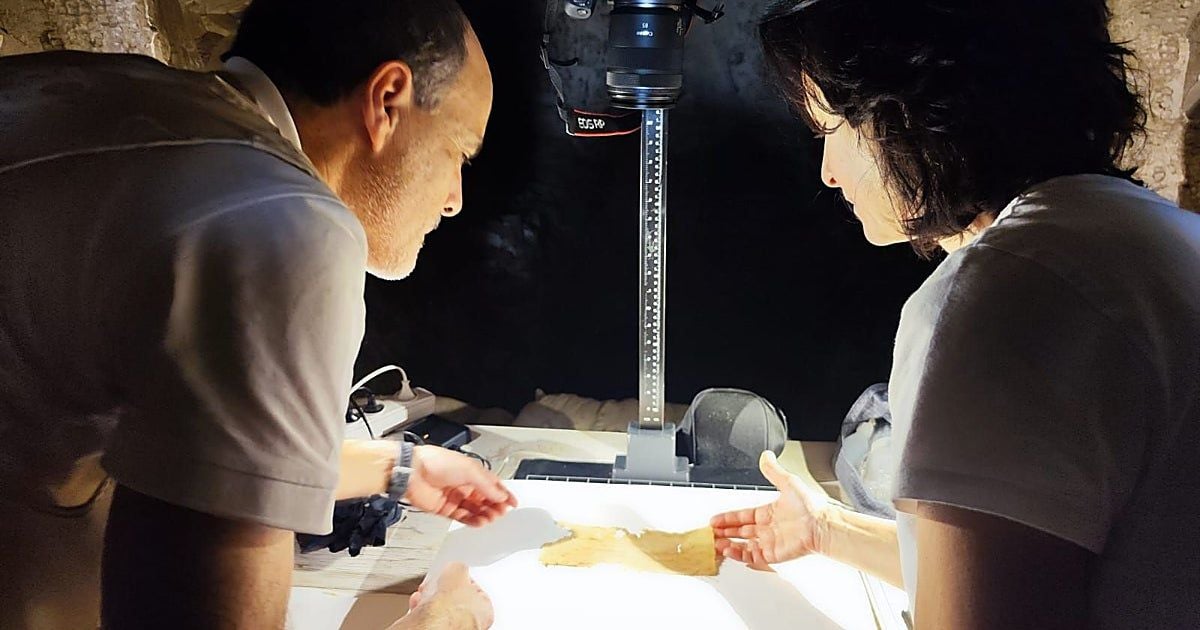
Laura Alba Carcelén, a specialist at the Museo Nacional del Prado, and Juan José Murillo Fuentes, of the University of Seville, examined material from the excavation at the invitation of co-director José Ramón Pérez-Accino. The method grew out of more than a decade of collaboration between the Prado and the university. That work produced Aracne, a program that uses technical images and X-rays to measure thread density, the orientation of warp and weft, and irregularities in woven cloth.
At the Prado, comparing these features has helped researchers trace connections between paintings. Analysis of Rubens’s copies of Titian’s Adam and Eve and The Rape of Europa showed that their canvases came from the same roll. The material beneath a painting can therefore offer clues to how it was made.
Using the method on archaeological textiles requires its own testing. In Luxor, the fragments were selected, prepared and photographed at high resolution under preventive conservation protocols. The images can then be analysed digitally, including away from the excavation.
The team is assessing how accurately the algorithms work with ancient plant fibres and adapting them to archaeological weaves. Its stated aim is a reproducible, non-invasive way to classify the finds, compare fragments and study how the textiles were made.
- Università di Siviglia ETSI — Applicazione a Luxor
- Università di Siviglia — Vicerettorato alla ricerca
- Museo Nacional del Prado — Aracne
- Università Complutense — Il progetto C2 nella necropoli tebana
- ABC — Resoconto del 16 ottobre 2026
- Progetto C2 — Collaborazione Aracne
- Università di Siviglia — Studio delle tele pittoriche
- GAPSC Università di Siviglia — Descrizione di Aracne