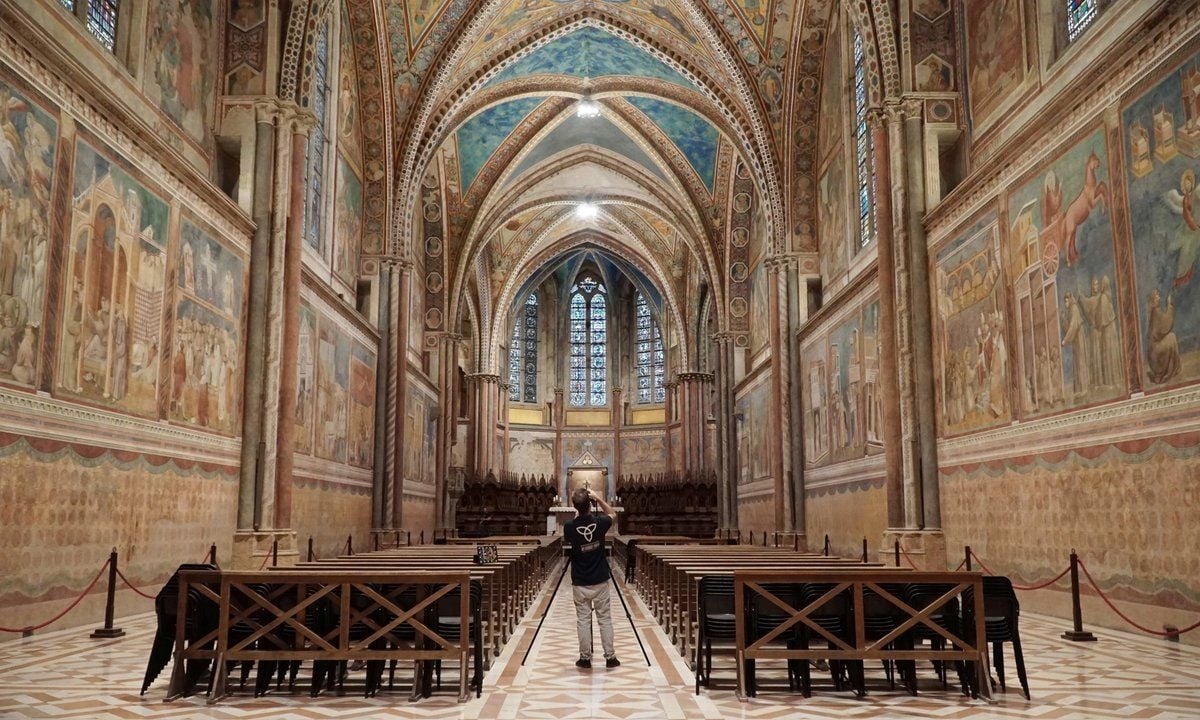
In the 1990s, the vaults of the Upper Basilica in Assisi were photographed as part of an editorial project. After the 1997 earthquake, which caused parts of the basilica to collapse, those images acquired a different value: they contributed to the work of identifying and repositioning fragments of the fallen frescoes. Documentation created to show the artworks also became a tool for their conservation.
That experience helps explain the significance of Preserving Assisi, the digital platform presented in September 2026. The project allows people to explore the Basilica of Saint Francis remotely while building detailed documentation of the complex. It is promoted by Haltadefinizione and the General Custody of the Sacred Convent, in collaboration with the University of Florence.
Through 360-degree panoramas, users can move through the Upper Basilica, the Lower Basilica and the exterior spaces. From there, they can access ultra-high-resolution images of the frescoes and examine details that may be difficult to distinguish during an ordinary visit.
One example is Pietro Lorenzetti’s Crucifixion in the southern transept of the Lower Basilica. The image created in July 2026 contains almost eight billion pixels. But its value lies in more than the ability to magnify a detail: the photograph also records the appearance of the work at a specific moment in time.
More than 27,000 photographs were acquired during the 2025 and 2026 campaigns. The work is still continuing, with further acquisitions planned through 2027. The images and surveys will also contribute to the development of a digital twin of the basilica, which is still in progress.
For the public, Preserving Assisi offers a different way to approach the spaces and artworks. For those who study and conserve them, it creates a visual record of the complex as it exists today. In the future, these same images may be compared with new acquisitions to identify alterations and changes.
This may be the project’s most important contribution: to document what exists today with enough precision to understand tomorrow what has changed.


