Beneath the Oppian Hill, in the gallery that supported the portico of Trajan’s Baths, two large decorations from the first century AD have been preserved. The first depicts a walled city seen from above. The second once covered the walls of a monumental room and combines architecture, figures and views of buildings overlooking the sea.
Discovered during excavations in the 1990s and recently restored, the Painted City and the Great Mosaic are now accessible to the public. Visits began on 12 September 2026 and take place by reservation. For individual visitors, each session is limited to a maximum of fifteen people. This is not yet a regular opening: the phase is experimental and will also be used to assess the impact of human presence on the conservation of the works.
In an underground environment, the arrival of people changes the existing conditions. Temperature, humidity and air quality can vary; lighting and the frequency of visits must also be compatible with materials that have remained protected for centuries. Limiting access does not therefore mean keeping the public at a distance. It means seeking the conditions in which the encounter with the works can continue over time.
The route was prepared through an intervention that addressed restoration, excavation and visitor reception at the same time. A connecting walkway, new lighting systems, resting areas and interpretation displays have been installed. The restoration of the decorated surfaces included the removal of deposits, consolidation and the filling needed to protect the surviving parts.
The Painted City is a fresco covering approximately ten square metres. It represents, from an aerial view, a city surrounded by walls and towers, with buildings arranged in perspective. A theatre, a temple and public spaces can be identified, but we do not know which city is depicted. Claudio Parisi Presicce, superintendent for Capitoline Cultural Heritage, believes it must have been a place well known to those who viewed the image. Its identification, however, remains open.
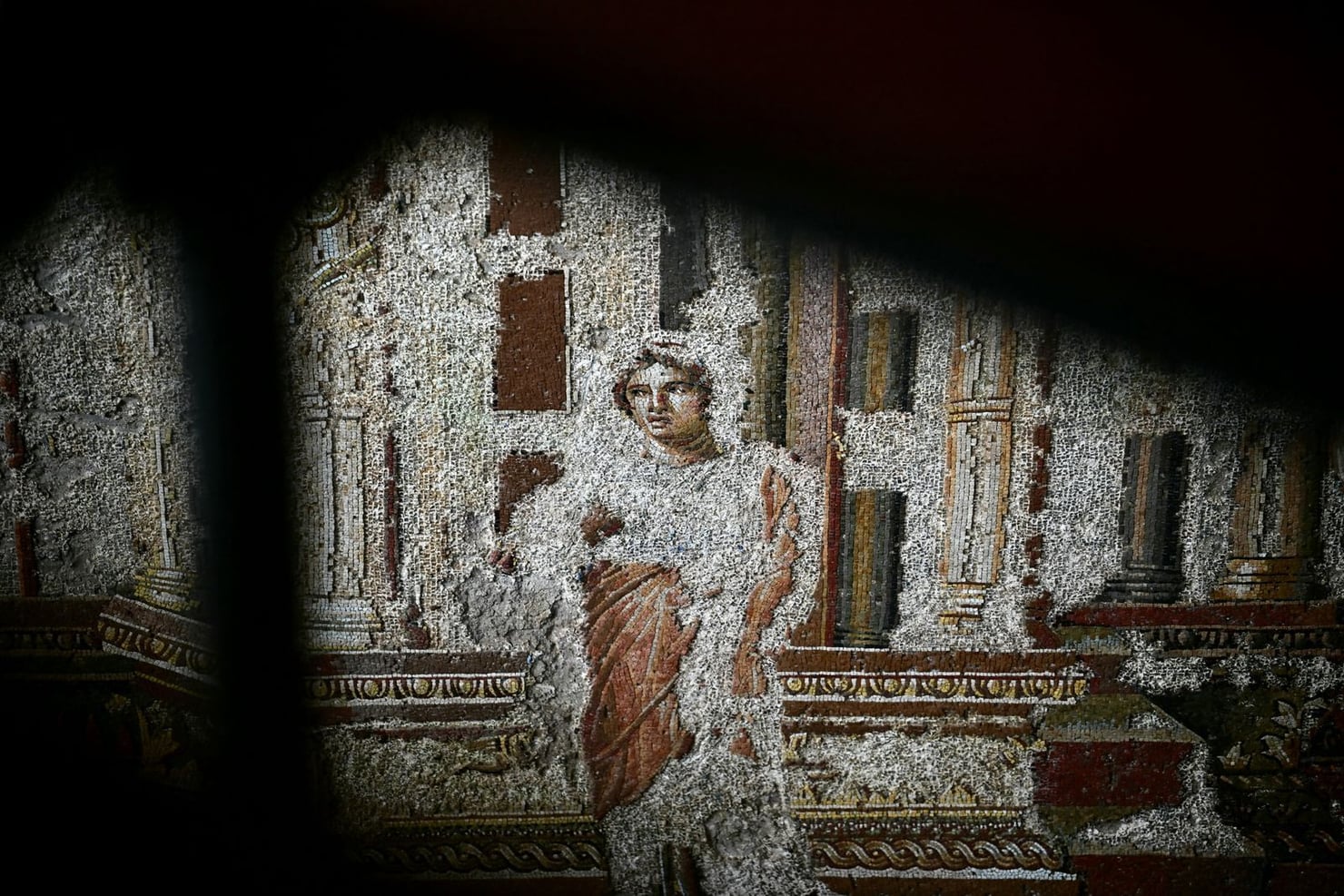
The Great Mosaic, by contrast, belonged to a large room overlooked by a nymphaeum. The section brought to light so far reaches approximately five metres in height and reproduces a complex theatrical architecture, arranged across several levels and populated by statues and figures. The enlargement of the excavation has revealed a new decorated band showing a port city, made up of buildings probably facing the sea. The walls of the room must have reached an overall height of approximately twelve metres.
The fresco and the mosaic belong to buildings that predate Trajan’s Baths, inaugurated in AD 109. The large bathing complex incorporated older structures, including parts of the Domus Aurea. Several phases in the history of the Oppian Hill thus overlap in the same place: the Neronian and Flavian rooms, the later construction under Trajan, the transformations that took place over the centuries, and the contemporary excavation and restoration work.
The exedra above also helps to show how complex Roman baths were as places. The two rows of niches may have held cupboards intended for books and documents; the steps would have accommodated people during readings and meetings. Activities connected with caring for the body existed alongside sport, social life and culture.
The visit therefore makes it possible to enter a space that has not yet finished yielding information. Archaeologists continue to investigate the extent of the mosaic and the layout of the rooms; in the meantime, those responsible for conservation will have to observe how the new access affects their equilibrium.
The fifteen people admitted to each session are not simply the first visitors to two works that remained invisible for so long. Their presence introduces a new condition, which will have to be measured and understood. In this case, making an archaeological site accessible is not the final act of restoration: it is a choice that becomes part of its history.


