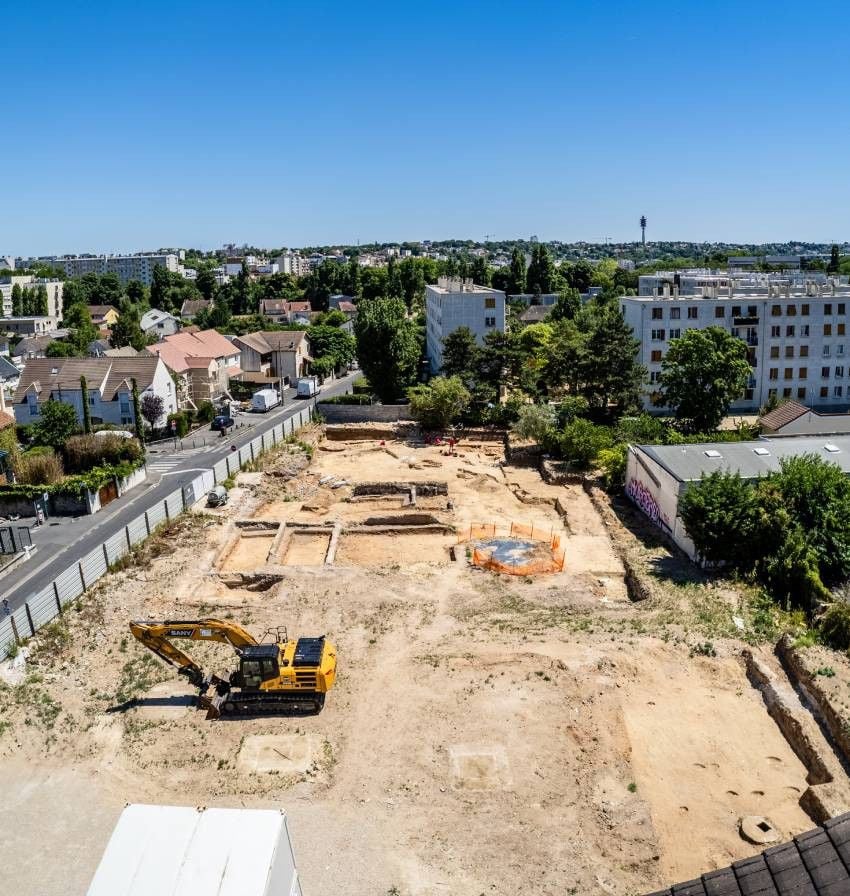
The eleven graves are only part of the complex discovered at Champigny-sur-Marne, near Paris. France’s National Institute for Preventive Archaeological Research (Inrap) also reports thirty megalithic blocks, including a statue-menhir, and timber structures. The site dates to the Middle Neolithic, between 4750 and 4300 BC.
The remains lie on a terrace in the Marne valley. As reported by La Clé publique, the site offers an unusual opportunity to study graves, monuments and other features together, whereas burials from this period in the region are more often found in isolation.
The largest monument is a sandstone statue-menhir, just over three metres long and weighing an estimated 9.7 tonnes. An engraved belt helps define its stylised human form, while small circular hollows mark the surface. Black and white patches could be traces of pigment, although this interpretation requires confirmation. The stone was found lying in the pit where it had originally stood.
Eight graves are grouped south of an earth mound; three others lie further north, near the statue-menhir and two smaller stone blocks. Most of the deceased were buried lying down. Some graves contained stone blades, projectile points and worked bone objects.
One adult, however, was buried seated in a narrow circular pit, with the lower legs and feet encased in calcite. The significance of this different burial position remains unclear.
The earth mound covered around thirty square metres and was associated with a small broken stele, pits, stones and traces of posts. No burial was identified beneath it, and its role within the complex has yet to be determined.
Planned genetic and isotopic analyses of the human remains may provide information about the diet, origins and mobility of the people buried there.